

Suppose you pulled a copy of your credit report today and discovered that you have a collection from Berlin-Wheeler, Inc. You opened the letter they sent you, read through it, and realized that you have no knowledge of the debt they're trying to collect.
That is exactly what happened to a woman we will call Danielle. She was preparing to apply for a mortgage when a routine credit pull revealed a $1,247 collection from Berlin-Wheeler tied to an old medical visit she thought her insurance had covered years ago. Her credit score had dropped from the mid-700s to the low 600s seemingly overnight, and with a home purchase on the line, the pressure to simply pay the balance and move on was enormous.
I'm guessing you're in a similar situation. And I'm guessing you need some help. I hope that's why you're here.
Danielle's situation isn't unique. According to a study done by the U.S. Public Interest Research Groups, 79% of credit reports contain errors or inaccuracies. The majority of these errors occur on collection accounts.
What Is Berlin-Wheeler?
Berlin-Wheeler, Inc. is a debt collection agency that was originally founded in 1951 and was incorporated on June 8, 1961. They are currently headquartered in Topeka, Kansas.
On February 1, 2015, Berlin-Wheeler was acquired by Wakefield & Associates, Inc., a revenue cycle management company based in Aurora, Colorado.
What We Know
Berlin-Wheeler has been around for 75 years and has been accredited by the Better Business Bureau since 1969. They have approximately 300 complaints filed with the Consumer Financial Protection Bureau and 116 complaints filed with the BBB in the past 3 years.
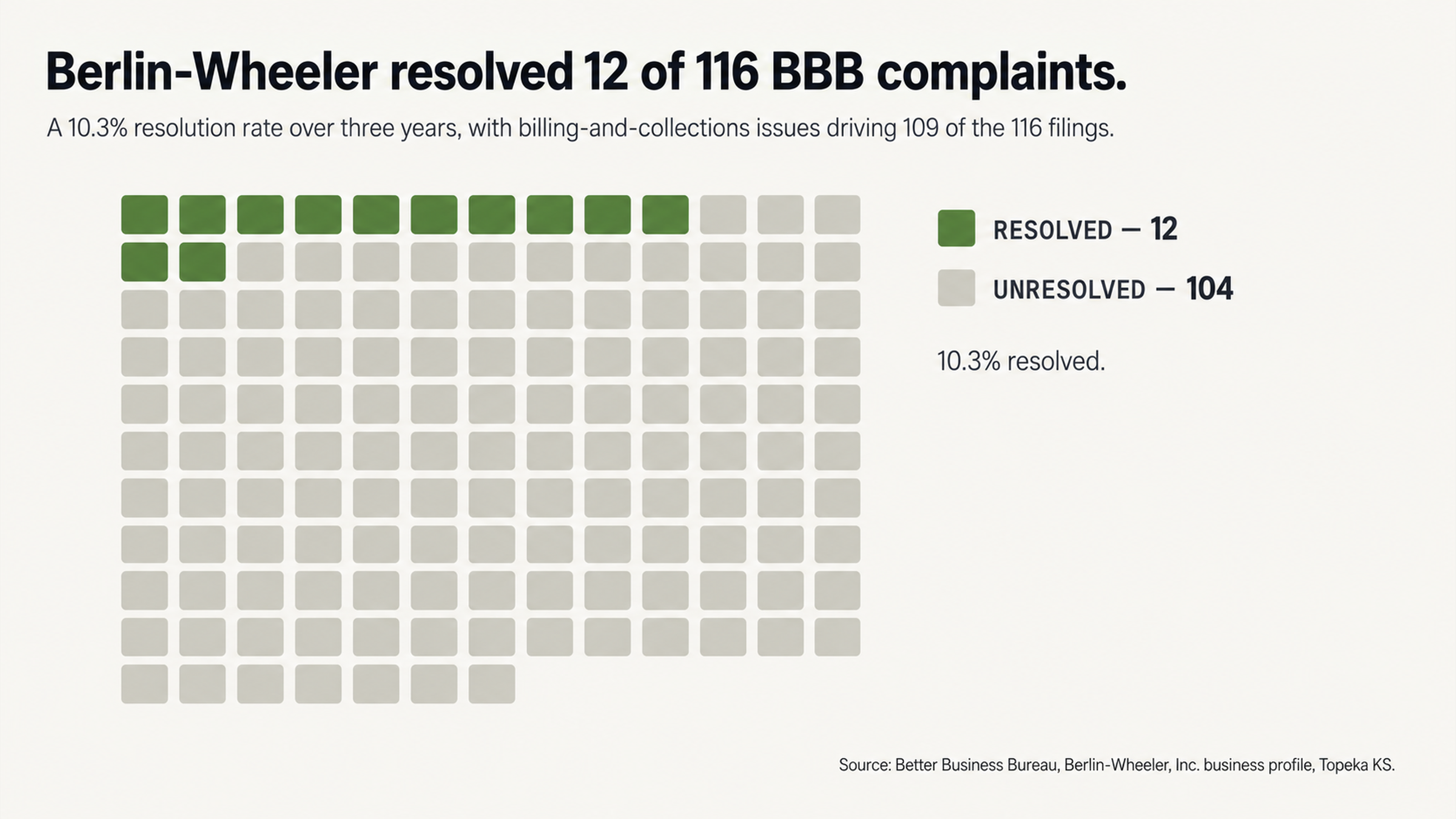
Of the 116 complaints filed with the BBB, 109 of them were complaints about billing and collections issues. Only 12 of the complaints filed with the BBB have been resolved. That's a 10.3% resolution rate.
In addition to complaints filed with the CFPB, Berlin-Wheeler has been sued in over 60 cases in federal court according to records obtained through PACER by consumer protection attorneys. Allegations in those cases include violations of the Fair Debt Collection Practices Act (FDCPA), the Fair Credit Reporting Act (FCRA) and the Telephone Consumer Protection Act (TCPA). B
Berlin-Wheeler was sued 7 times in a two-year period for debt collection harassment alone. Most telling is Berlin-Wheeler's approach to answering formal complaints. In nearly all of the CFPB complaints examined the company issued the same generic response and opted not to provide a detailed explanation.
The lack of transparency prevents consumers (and regulators) from assessing whether Berlin-Wheeler's position has any merit.
Why Paying Berlin-Wheeler Could Hurt You
The Payment Trap
Danielle's initial response to the collection on her credit report was the same as most consumers: Pay the collection and make it go away. That seems reasonable enough, right? But the truth about paying collections is one of the most widely misunderstood aspects of the credit scoring system. When you pay a collection it is marked "paid" on your credit report.
But here's the catch: A paid collection remains. When you pay the collection the status is updated to reflect the account has been paid, but the account itself doesn't go away. In fact, paying a collection can sometimes cause a temporary drop in credit scores.
A paid collection is still a derogatory mark and it can "re-age" the original delinquency date associated with the account. Paid collections remain on your credit report for seven years from the original delinquency date. The seven-year clock does not start over.
Most consumers who pay a collection expecting it to be removed are dismayed when they find little to no change in their credit scores.
The Original Creditor Has Already Moved On
Another important fact that consumers rarely consider: By the time a debt ends up on Berlin-Wheeler's doorstep the original creditor (e.g. a hospital, utility company, credit card issuer, etc.) has long since written the account off as a bad debt. They may have sold the debt or placed it for collection, but the original creditor has already moved on.
Debt buyers, like Berlin-Wheeler, purchase accounts for pennies on the dollar, often around 4 cents per dollar. Danielle's $1,247 medical bill may have been purchased for less than $50. The original creditor has no financial interest in whether or not the debt is collected.
This matters because it changes the way consumers should think about the "obligation" implied by debt collection. The revenue generated by Berlin-Wheeler comes from the difference between what the company pays for a debt and how much it can coerce a consumer to pay.
This profit motive, not a legitimate duty to the original creditor, is what underlies the collection efforts. Knowing this can help you brush off the emotional triggers that debt collectors rely on.
The Pattern of Problems with Berlin-Wheeler
Collecting from the Wrong People
The most concerning pattern in the Berlin-Wheeler complaint history is the frequency with which the company targets the wrong people. This is not a one-off clerical error. It shows up in BBB complaints, CFPB complaints, and the intake records of law firms over the course of more than a decade.
A consumer named Colleen reported that Berlin-Wheeler called her constantly despite the fact that she had never been in debt to anyone and had no unpaid obligations. She believed a hospital called CoxHealth had wrongfully attached her name to another person's debt and passed it along to Berlin-Wheeler. Despite contacting the hospital multiple times, she could not get her name removed. As a senior citizen, she expressed fear that the erroneous account would damage her credit.
Another consumer reported that Berlin-Wheeler "mailed me a bill for over $4,000 from someone else . . . When I called and told them this, the girl I talked to seemed to indicate this was a normal occurrence." If a debt collector's own employees seem to think it's "normal" to misidentify consumers, that's a scary thought.
Debt Validation Failures
The Fair Debt Collection Practices Act guarantees the right of every consumer to request that a debt collector validate a debt in writing. Berlin-Wheeler's responses to debt validation requests have been a source of litigation for the company for years.
In October 2018, Lemberg Law reported on a case in which a consumer sent Berlin-Wheeler a certified debt validation request. Berlin-Wheeler responded with "copies of invoices, an itemized printout, and a demand for payment," but did not validate the debt. As the FTC has explained, an itemized printout is not enough to validate a debt.
In another case, Berlin-Wheeler was sued for its failure to validate a debt when the consumer requested proof of a signed original contract to establish that the debt was valid. Berlin-Wheeler was unable to produce the contract, and the debt was dismissed along with three adverse credit reporting marks.
"Berlin Wheeler should try to change their procedures to be accurate, more honest, and not so hyper aggressive out of the box," wrote a BBB complainant in June 2025. The complaint goes on to describe how Berlin-Wheeler inaccurately claimed to have already sent written notice of the debt, and only provided any documentation after the complaint was filed.
These outcomes raise questions about whether many of the debts Berlin-Wheeler collects stand up to even basic legal tests.
Why You Should Dispute Instead
How the Dispute Process Helps You
This is where Danielle's case diverges from the norm. Instead of paying the $1,247 balance, she decided to dispute the account.
When a collection is disputed through the credit bureaus, the collector has a short period of time, in many cases, just 30 days, to verify that the information is correct. If they can't, the account is deleted. This is the dirty little secret that collectors wish you didn't know.
Collectors often fail to fulfill their validation responsibilities when a dispute is properly submitted. Debt buyers may purchase accounts without full records of payment history, original contracts, or records of chain of ownership. If any of those are missing, the verification cannot be completed.
Berlin-Wheeler's complaint history indicates this may be a vulnerability. With nearly 300 CFPB complaints, many of them alleging failure to validate debts, the company may have a systemic records problem. That's not a guess. It's a pattern documented in federal court cases, regulatory complaints and the company's own failure to produce signed original documents in at least one instance.
Permanent Removal Is the Goal and It Is Possible
The most important point to understand about a successful dispute is that removal is usually permanent. If a collection account is removed from your credit report because the collector failed to verify it, there is no way for that collector to put the account back on. Collectors who couldn't produce records the first time rarely decide to do so later.
That's in contrast to payment, which leaves the account on your report for years. Dispute and removal eliminates it.
For someone like Danielle, who is preparing to apply for a mortgage, the difference between paying a collection (which would leave the account on her credit report and drag down her credit score) and removing the account altogether might mean the difference between qualifying for a good interest rate or not qualifying at all.
Credit repair takes time. You have to wait for investigation periods, responses from the credit bureaus and more. But the end result of a successful dispute far exceeds the instant gratification of mailing a check to a company that may not even be entitled to collect the debt in the first place. It's a process that rewards people who can delay their impulse to just pay.
How to Protect Yourself from Berlin-Wheeler's Practices
Never Talk without Knowing What You're Talking About
If Berlin-Wheeler is calling you, the best course of action is to say nothing.
Do not confirm your identity. Do not admit to owing money. Do not give out your bank account or credit card numbers. Any information you provide on the phone gives the collector leverage to strengthen the status of the debt and can reset statutes of limitations if the debt is too old to be enforced. (See below for a discussion on statute of limitations.)
At least two consumers have reported that Berlin-Wheeler's caller demanded personal identifying information before identifying themselves.
One 2018 complaint, filed in conjunction with hiring a consumer attorney, noted that the caller demanded confirmation of the consumer's name and address before they would identify their employer or the purpose of the call.
Attorneys say this is one of the telltale signs of a collector trying to get information from a consumer before that consumer is in a position to verify the facts of the debt or the law. If you get a call like this, say nothing. It's not irresponsible or unresponsive; it is responsible and wise.
Keep in mind that anything you say on that call could be used against you. Before you say a word, you need to know what the collector is claiming, whether you actually owe that money, and whether the dates and amounts are correct. None of that can be verified over the phone with someone who has an incentive to twist your words. All communication should be in writing.
The Calling Pattern to Look Out For
Berlin-Wheeler's calling practices are where some of the most detailed descriptions can be found. Many of the complaints describe calls that are very similar.
Mozaiah Thompson, whose complaint was outlined above, reported getting "at least 10 calls a day, and numerous calls outside the allowed calling hours" before 8 am and after 9 pm Central Time. Thompson added that the company was masking its caller ID to appear as though the calls were coming from American Airlines or Delta Airlines, which could violate the Truth in Caller ID Act as well as the FDCPA.
A September 2025 BBB complaint describes Berlin-Wheeler calling the consumer's cell phone every working day during work hours, never leaving any information about the nature of the call, and eventually moving to the consumer's work phone number. This pattern repeats in complaints over the years and suggests an approach that values quantity over adherence to the law.
If you are getting calls like this, you should definitely make a record of it, including times, the displayed caller ID, frequency, and the content of what the caller says. That could serve as valuable evidence in the event that the account is disputed or if the situation escalates to court action. But do not engage with the caller. Allow the record to be your voice while a professional takes the lead.
Why Professional Help Is Indispensable
The Mistake Most Consumers Make
Danielle thought she might try to handle this on her own. She read some articles and found a few sample letters online and figured that she could save money by going solo. She did not realize that disputing the debt requires more than just sending a letter.
You have to know which credit bureau(s) to contact. You have to know how to word your dispute so that it compels a full investigation. You have to know what documentation to request. And you have to know how to respond when the creditor tries to brush you off or sends an incomplete response.
Collectors are counting on you making a procedural error. If your dispute is worded the wrong way, addressed to the wrong party, or delivered without the right documentation, the credit bureau can reject it without a real investigation. Berlin-Wheeler has shown over and over that it provides the least response necessary in any situation.
Consumers who do not understand how to push back when that happens will end up in the same place they started, with the same negative mark dragging down their credit score. Complicating matters further was Berlin-Wheeler's 2015 acquisition by Wakefield & Associates. Some of the CFPB complaints filed against Berlin-Wheeler list Wakefield & Associates as the accused entity.
The fact that the two companies are closely related can cause confusion about whether the account in question actually belongs to Berlin-Wheeler. A professional will be more equipped to sort out this confusion.
What a Credit Repair Professional Does Differently
A credit repair professional does not simply fire off letters. They review your credit report, determine all potential inaccuracies and dispute opportunities, and develop a strategy to push collectors to validate the debt or have it removed. They are aware of the necessary time-frames, the necessary documentation, and the common ways that collectors will attempt to bypass their responsibilities.
In Danielle's case, a professional review of the account found that the original date of the debt, the current balance, and the credit report chain of ownership were all potentially inaccurate.
The dispute was filed within the appropriate time-frame, and when Berlin-Wheeler failed to validate the debt within the prescribed investigation period the account was deleted from all three credit reports. Danielle's credit score bounced back, and she was able to proceed with her mortgage application.
While it is impossible to guarantee similar results in every case and irresponsible to promise a certain number of points, the process typically works because it utilizes the same rules meant to protect consumers. When those rules are applied correctly, collectors who cannot validate a debt are unable to report it.
Conclusion
Berlin-Wheeler, Inc. has been in business for over 75 years, but that does not mean the company is operating on the up-and-up if it has garnered nearly 300 CFPB complaints, 116 BBB complaints, been sued in federal court over 60 times, and has a history of attempting to collect from individuals who do not actually owe them money.
If you find Berlin-Wheeler, Inc. on your credit report, you are not dealing with a simple annoyance. You are dealing with a legitimate threat to your financial well-being that demands an informed and strategic response. The temptation to simply pay the debt and move on is understandable, but it is almost always the wrong course of action.
Paying the debt does not remove it from your credit report. Paying the debt does not restore your credit score. Paying the debt does nothing to hold the collector accountable for the mistake that put the account on your credit report in the first place. Disputing the debt through the proper channels is the only strategy that offers the possibility of having the account completely removed.
Danielle's story had a happy ending because she resisted the urge to react out of fear and instead decided to react out of knowledge. She did not call Berlin-Wheeler, Inc. on the phone and offer to pay. She did not put a check in the mail. She reached out for professional help, and the collection was deleted.
Take the First Step Today
If Berlin-Wheeler, Inc. is reporting an account on your credit report, you do not have to go through the experience alone.
At FightCollections.com, we specialize in pushing back against debt collectors by disputing accounts that are inaccurate, unverifiable, and flat-out wrong. We know the games that companies like Berlin-Wheeler, Inc. like to play, and we know how to challenge them.
Contact us today to schedule a free consultation. Let us review your credit report, identify every possible point of attack, and develop a strategy designed to get the collection removed. The longer an inaccurate collection is allowed to remain on your credit report, the more harm it can do.
The time to act is now, and the right course of action is to dispute.