

You just found AscensionPoint Recovery Services on your credit report. You didn’t ask for this company in your life. In fact, you’d never heard of it until it showed up on your report.
Before you have a nervous breakdown or start writing a check, read this carefully: the burden of proof is not on you.
The debt collection business model relies on one overarching assumption: most people will pay anything to shut a debt collector up. AscensionPoint operates on the same assumption as every other debt collector. The problem for them is that you don’t have to play by those rules.
Everything they report about you must be accurate, verifiable, and something they’re legally allowed to collect on. If any of those three conditions is not met, you have grounds to dispute the account. In many cases, you can even get it deleted.
So, Who Is AscensionPoint?
AscensionPoint Recovery Services, LLC is a Minnesota-based, third-party debt collection agency. The company has made a name for itself in decedent debt recovery. Decedent debt recovery is a nice way of saying they collect from the estates of people who have passed away.
Here is the company’s essential information:
The company has a second office at 600 Highway 169 S, Suite 1520, Saint Louis Park, MN 55426. They’ve been a BBB-accredited business since December 2008. The company is also licensed to operate in California, New York, Texas, Florida, and several other states.
What Does Their Complaint History Say?
There are more than 100 complaints about AscensionPoint Recovery Services in the Consumer Financial Protection Bureau (CFPB) database. The overwhelming majority of them allege the company attempted to collect a debt they didn’t actually owe. Many of those consumers also report that the company contacted them, even though they had no association with the estate of the deceased.
In one complaint, a woman received a letter from AscensionPoint that was addressed to “The Estate of [her name]”. The letter informed her that she was deceased. She was shocked to discover she was dead. She questioned whether the company simply sent letters to anyone whose name matched an obituary, regardless of whether they were actually the person who had passed away.
In another complaint, the consumer said that AscensionPoint contacted her bank and told them that she was deceased. As a result, the bank canceled two of her credit cards. Later, the company acknowledged that they had placed the account in error at the behest of their client. These aren’t isolated incidents. They’re patterns that appear over and over in the federal complaint database.
What Does Their Rating Actually Mean?
The BBB Paradox
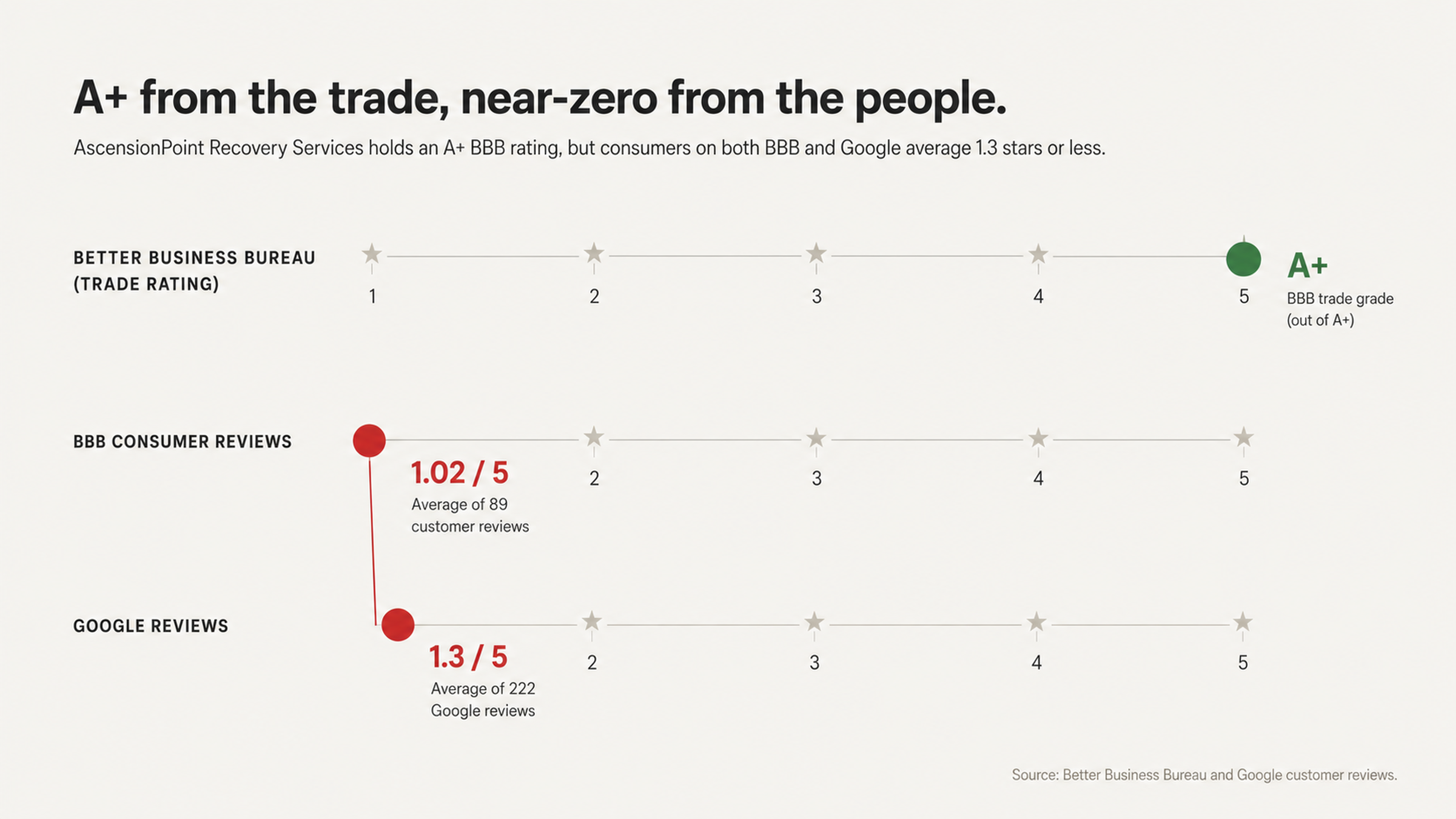
AscensionPoint maintains an A+ rating with the Better Business Bureau. That sounds great until you read the actual reviews. The company averages 1.02 out of 5 stars based on 89 customer reviews. Almost every single one of those reviews was one-star, the lowest rating possible.
Their reviews on Google aren’t any better. AscensionPoint averages 1.3 out of 5 stars across 222 reviews. Again, the vast majority of those reviews were the lowest rating possible.
That’s why their rating with the BBB doesn’t matter to you. The BBB evaluates companies based on how well they respond to their customers, not whether their customers are actually happy. Debt collection agencies don’t need you to like them to make a profit.
One BBB reviewer reported that an AscensionPoint representative called her 20-year-old daughter away at college and informed her that her mother was dead. They asked her to establish an estate. The mother was still very much alive.
Another reviewer reported that AscensionPoint called and asked if she was the authorized representative of her mother’s estate. They offered their condolences on her loss. She informed them that her mother was still alive.
Why the Complaints Don’t Change Anything
To understand why AscensionPoint continues to rack up complaints without changing its behavior, you need to understand its business model. Debt collection agencies make money on volume. They buy or are assigned large batches of accounts and attempt to collect on all of them.
It takes time and money to verify each account. If they call the wrong person or the person is actually deceased, it doesn’t cost them anything as long as that person pays them to go away. They don’t need you to like them to stay in business because they don’t rely on you as a customer. You’re not a customer; you’re a target.
The customers are the original creditors who hire them based on their recovery rate, not their customer satisfaction scores. That’s why the complaints haven’t changed their approach. The complaints come from their targets, not their customers.
Their Legally Vulnerable Spots
Federal Lawsuits Reveal the Truth
According to court records, there have been at least six federal lawsuits filed against AscensionPoint in several different states. Most of them allege violations of the Fair Debt Collection Practices Act (FDCPA). Each of those cases lays out specific behaviors that may have happened to you.
In one of those cases, Machnik v. AscensionPoint Recovery Services, the plaintiff alleged that the collection letters AscensionPoint sent did all of the following:
Failed to specify the actual debt and creditor. Used a vague phrase indicating that there were “outstanding bills due.” Failed to disclose the consumer’s right to dispute the debt. Failed to clearly state that the communication was from a debt collector.
The case was filed in the Eastern District of Wisconsin in 2018 and was voluntarily dismissed after about eight weeks. When federal cases are dismissed that quickly, it almost always means the company paid the plaintiff to go away.
In another case, Ismail v. Ascensionpoint Recovery Services, the plaintiff alleged that the company was attempting to collect a time-barred debt and had failed to make all the required disclosures. The court ruled in favor of AscensionPoint in this case. However, the allegations themselves demonstrate the kinds of compliance issues consumers have raised.
The Documentation Gap
Complaints filed by consumers and court pleadings reveal several behaviors that create an opportunity for you to dispute their claims. Many of them allege that AscensionPoint collection letters fail to include the mini-Miranda disclosures that indicate the communication is from a debt collector.
Some consumers allege that the letters mention “outstanding bills” but fail to specify the actual debt and creditor. Some consumers report receiving multiple collection letters but never receiving a debt validation letter, even after requesting it. Some report that AscensionPoint has disclosed alleged debt information to family members who have no legal responsibility for the estate.
Each of those behaviors is a potential violation of federal law and a reason to dispute the account.
Studies by U.S. PIRGs have found that 79% of credit reports contain mistakes or serious errors. If a debt collector cannot validate who owes what to whom, then the information they put on your credit report may not be valid.
Your Rights Are Bigger Than Their Tricks
Silence is Not a Crime
Many consumers feel terrible because they don’t answer the phone when debt collectors call. Some consumers report that AscensionPoint called them more than ten times a day for more than 60 days. All that calling is designed to get you to answer the phone. Once you answer, you’re playing on their turf.
Under federal law, you have the right to make debt collectors stop calling you. That’s not rude or an admission of guilt. It’s a legal protection against harassment. Collectors prefer phone calls because there’s no paper trail. They can promise you anything over the phone to get you to pay. Later, they can deny it.
If you communicate in writing, there is a record of everything. If a debt collector agrees to remove a collections account from your report in exchange for payment, that agreement doesn’t mean anything unless it’s in writing. Verbal agreements with debt collectors are frequently broken because there’s no way to prove what they said.
Emotional Manipulation Tactics
Because AscensionPoint specializes in decedent debt, they sometimes end up in uniquely emotional situations. One BBB reviewer reported that she was undergoing chemotherapy while her husband was still alive when AscensionPoint called her. They told her that he was dead and demanded she set up an estate. Another reported that she received a call asking her to confirm that she was the authorized person on her mother’s estate. The caller offered condolences on her mother’s passing. She told them her mother was still alive.
Those aren’t situations in which you can have a calm rational conversation. Collectors know that when you’re upset and stressed, you’ll make a decision you shouldn’t. That’s why they call you within weeks of someone’s passing. They’re hoping you’re so grief-stricken that you’ll just pay them.
When you work with a credit repair professional, that emotional component gets removed from the equation. A third party can evaluate their claims objectively and respond accordingly. They can protect you from tactics designed to manipulate your emotions to get you to do something that isn’t in your best interest.
Getting Them Off Your Report
Why Paying Them Can Actually Make Things Worse
The temptation to just pay a collection agency what they want and be done with it is huge. Unfortunately, it’s usually a mistake. When you pay a collection, you change its status from “unpaid collection” to "paid collection". That’s it. The account remains on your credit report for years.
Paying it can also reset some of the legal clocks in your favor. If you have a debt that is approaching the statute of limitations, paying it or even acknowledging it can reset that clock. Suddenly, a debt you thought you were almost done with can remain on your report for another seven years.
What you want is to have the collection account completely removed from your report. That happens when:
The reported information cannot be verified as accurate. The account was placed in error. You can document that the debt isn’t yours. The collector fails to respond to your verification requests within the required amount of time.
Why Disputes Actually Work
AscensionPoint’s admitted history of misidentification provides you with all the grounds you need to dispute any account they place on your report. If the company has already acknowledged that it places accounts in error, that it contacts the wrong people, that it has falsely reported people who are still alive as dead, and that it has repeatedly failed to provide required documentation, then you have every reason to question the validity of any given account.
Credit reporting bureaus must investigate anything you dispute and remove it if they cannot verify it. Collectors must respond to your verification requests or stop trying to collect. The burden is on them to prove their claims, not on you to disprove them.
Professional credit repair experts understand what documentation a collector must provide and how long they have to do it. They understand which federal violations provide leverage and how to word a dispute for maximum effect. If you try to do this on your own, you’re navigating a system that is designed to favor the debt collector, not the consumer, and you probably don’t even know the rules.
What the Government Knows
Where Are the Regulators?
Despite more than 100 complaints to the CFPB and years of documented consumer allegations, there is no record of any formal action by the Federal Trade Commission (FTC), the Consumer Financial Protection Bureau (CFPB), or any state attorney general against AscensionPoint for violating debt collection laws. There is one confirmed government enforcement action against the company, but it had nothing to do with debt collection.
In August 2021, the Equal Employment Opportunity Commission (EEOC) announced that AscensionPoint would pay $65,000 to settle a religious discrimination lawsuit. The company had fired a Christian employee because he refused to be fingerprinted on religious grounds. They never explored accommodations for the employee’s religious beliefs.
While that tells you something about the company’s culture, it has nothing to do with debt collection.
The lack of a formal government action means you cannot rely on the government to protect you. There have been hundreds of complaints, but none of them have resulted in any meaningful government action. Your only protection is knowing your rights and enforcing them through the dispute process.
Court Records and Their Strategy
One thing that is clear from court records is that AscensionPoint does not appear to sue consumers to collect debts. Every documented federal case is a consumer suing them, not the other way around. That means their business model relies on voluntary payment, not legal enforcement.
Understanding that shifts the balance of power. A debt collector that cannot sue you doesn’t have a lot of leverage other than damaging your credit report and calling you repeatedly. Both of those tactics can be fought through the dispute process and restrictions on communication.
When the lawsuits against them settle in about eight weeks, as Machnik did, that usually means the debt collector would rather pay to make the problem go away than allow a court to evaluate their business practices.
That knowledge informs an effective dispute strategy.
The Bottom Line
AscensionPoint Recovery Services has more than 100 federal complaints against it. It has the lowest-possible consumer reviews on every platform. It has been sued multiple times for violating federal consumer protection laws. It has a documented history of falsely reporting people as dead, contacting the wrong people, and failing to validate debts.
Despite all that, they’re still putting accounts on people’s credit reports. Despite all that, the government has not taken any action against them. The only way you can protect yourself is to understand your rights and use them.
You didn’t ask for this company to be in your life. You don’t owe them the benefit of the doubt. Everything they claim must be proven. When they cannot do that, the account should be removed from your credit report.
So, what are you going to do about it?
At FightCollections.com, we specialize in disputing inaccurate, unverifiable, and erroneous collection accounts. We understand what documentation collectors must provide and the time limits that protect consumers. We handle the communication so you never have to talk to a debt collector again.
If you discover AscensionPoint Recovery Services on your credit report, don’t assume they’re right. Don’t pay them just to make the problem go away.
Contact FightCollections.com today for a free consultation to understand how we can help shift the burden of proof to where it belongs.