

Are you facing a collection account on your credit report from CBE Group? Understanding who CBE Group is will be important if you’re going to navigate the situation in an intelligent manner.
CBE Group, Inc., formerly known as Credit Bureau Enterprises, Inc., was founded in 1933 and changed its name to The CBE Group, Inc. in 1998. As one of the largest debt collection agencies in the country, CBE employs over 1,200 employees and has over $93 million in revenue annually. CBE Companies, Inc. is their parent company, and they’ve been a Better Business Bureau accredited business since January 11, 1992.
What’s Wrong with CBE Group?
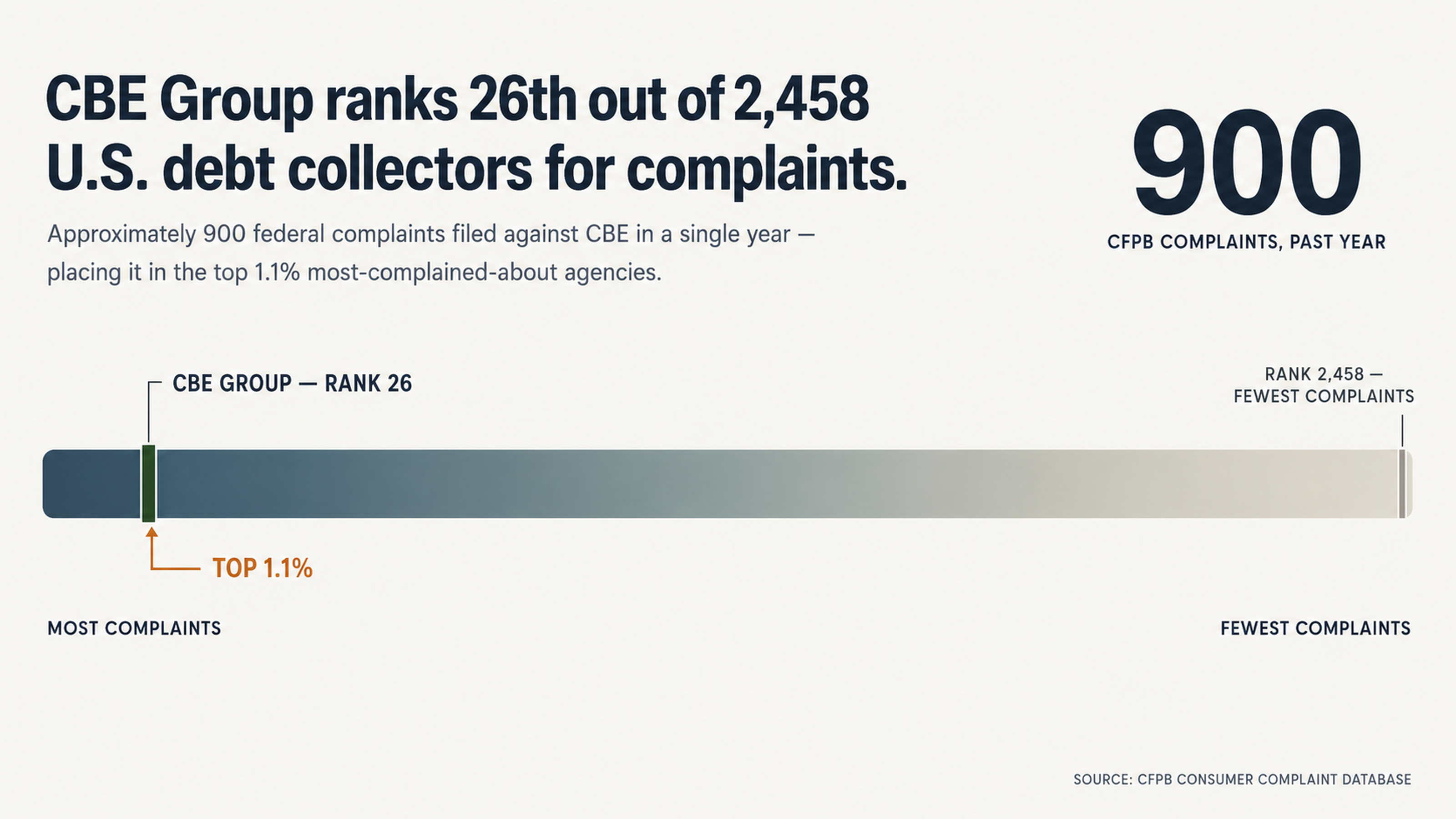
CBE Group has an estimated 900 complaints filed against it with the Consumer Financial Protection Bureau (CFPB) in the past year alone, placing it 26th out of 2,458 companies in the number of complaints filed with the CFPB about debt collection. On the Better Business Bureau (BBB) website, CBE Group has 274 complaints in the last three years, with 51 closed in the past year alone. With a 1.2-star rating on Google Reviews from over 600 reviews, one reviewer on the BBB website writes, “Do not trust this company. SCAM!!! I would give 0 but that choice is not an option.”
Despite its A+ rating from the BBB, largely due to its response to complaints, CBE Group, Inc.’s reviews from actual consumers paint a different picture. But what’s more important is that the credit reporting system is so fundamentally flawed that it’s biased toward debt collection agencies, not consumers. According to a study done by U.S. PIRGs, 79% of credit reports contain either mistakes or serious errors. Once you know that the system is flawed, your approach to the situation will change dramatically.
How to Dispute CBE Group
Debt Validation
Under the Fair Debt Collection Practices Act (FDCPA), a debt collector is required to validate the debt if the consumer requests it. This includes providing documentation that proves the debt is yours, that you owe the amount they’re saying you owe, and that they have the right to collect it. By looking at CBE Group’s complaint history, we see that the company has had issues in the past when trying to validate debts.
The majority of complaints about debt collection (45%) to the CFPB in 2024 were about attempts to collect debts that consumers didn’t owe. We see consumers complaining to the CFPB that CBE Group will not provide them with debt validation documentation. One reviewer writes to the CFPB, “I have previously submitted a complaint against CBE Group for contacting me after a cease and desist was requested. On multiple dates I received calls from CBE Group. This is harassment and the company previously assured me I would not get any more calls.”
Debt validation is a legitimate reason for disputing the debt. If the credit reporting agency cannot validate the debt, it must be removed from your credit report. The burden of proving the debt is on the debt collection agency, not you.
Failure to Provide Documentation and Lawsuits
CBE Group has been sued in the past for failure to provide adequate documentation and other legal infractions. In June 2024, a class-action lawsuit was filed in the U.S. District Court for the Southern District of New York against CBE Group for its attempts to collect a Verizon Wireless debt that the plaintiff had already paid in full to another collection agency. The lawsuit is seeking class certification for all New York consumers who had a similar experience with CBE Group.
In 2017, another lawsuit was filed in federal court claiming that CBE Group demanded the plaintiff pay a collection fee of $798.67 that he did not contractually or legally owe. Another 2017 lawsuit claimed that CBE Group inaccurately represented the amount of debt the plaintiff owed when sending him letters. The plaintiff received one letter claiming he owed $2,336.01, when in fact his credit report showed he owed $357 less.
These lawsuits demonstrate CBE Group’s history of attempting to collect unauthorized fees, debts that have already been paid, or misrepresenting the amount of debt a consumer owes. All of these infractions are possible violations of federal law and grounds for disputing the credit reporting.
Why You Should Not Pay CBE Group
Paying a Collection Does Not Remove it from Your Report
When you see a collection on your report, you might assume that paying it will get it removed. This is a costly assumption for some consumers. When you pay a collection account, the collection is noted as “paid” instead of “unpaid,” but the account will still remain on your credit report for seven years from the original delinquency date.
Having a collection account on your report, whether paid or unpaid, is still damaging to your credit report. Paying it will not remove it from your report or restore your credit score. You will have paid the collection agency, but the damage to your credit will still exist. This is why paying a collection is sometimes a counterproductive first move.
Debt collection agencies will use urgency and fear to get you to pay a debt immediately. Once you’ve paid, you have no bargaining power. You should negotiate removal before you pay, and any agreement you make over the phone is not enforceable.
Why Disputes Sometimes Work
Disputing the accuracy of the information on your report works because it requires the collection agency to verify the debt information. If CBE Group cannot verify your debt within a reasonable amount of time, the credit reporting agency must remove the information from your report. Given CBE’s history of failure to provide adequate documentation and other compliance issues, verifying the information can sometimes be a problem.
You can remove information from your report if it’s inaccurate, incorrect, fraudulent, or unverifiable. Given the error rate in credit reporting, there’s a good chance that information about a collection account on your report is incorrect, whether it’s the amount, the dates, or the fact that the debt isn’t yours at all.
Working with a professional credit repair agency means working with people who understand the process and the law. Collection agencies have entire teams dedicated to collecting debts and have developed scripts and protocols over decades to get consumers to pay. When you work alone, you are at an informational disadvantage, a disadvantage that the industry has created.
CBE Group’s Federal Contracts and the Lack of Oversight
Despite thousands of consumer complaints and multiple class-action lawsuits, CBE Group has been awarded federal contracts. In fact, it’s one of three private collection agencies approved by the IRS to collect delinquent federal taxes under the Fixing America’s Surface Transportation Act (FAST Act) of 2015. The company also collects debt on student loans for the U.S. Department of Education.
However, the awarding of federal contracts to private collection agencies has not been without controversy. In 2007, a congressional subcommittee took the IRS to task for paying private debt collectors up to 25% of the amount they collect when it costs the IRS far less to collect the debt itself.
Between fiscal years 2006 and 2009, the private collection programs “wasted tens of millions of dollars in commissions,” resulted in fewer collections “than anticipated,” and “contributed to inequities in the tax system,” according to the National Taxpayer Advocate, an IRS ombudsman, in its annual report to Congress.
In response to the criticism, Congress passed the Taxpayer First Act of 2019, which included new consumer protections, including a provision that bars the IRS from using private debt collectors to collect outstanding tax debts if the taxpayer’s income falls below 200% of the federal poverty level. It also requires that tax debts be at least two years old before they can be assigned to a private debt collector.
There is no public record of any major enforcement action taken against CBE Group by either the Federal Trade Commission (FTC) or Consumer Financial Protection Bureau (CFPB), nor are there any state Attorney General settlements, consent decrees, or compliance orders against the company.
It’s worth noting that while there have been thousands of complaints filed against CBE Group with the CFPB and multiple class-action lawsuits filed against the company alleging widespread violations of federal debt collection law, the company has not been the subject of any major enforcement action by either the FTC or CFPB. There are also no state Attorney General settlements, consent decrees, or compliance orders against the company.
That’s a problem because it suggests there is a lack of effective oversight of large debt collection agencies. While CBE Group has been the subject of more than 900 complaints filed with the CFPB over the last year alone and ranks 26th out of 2,458 companies in complaints about debt collection filed with the CFPB, and has been the subject of repeated lawsuits alleging it has engaged in systemic violations of federal law, there is no public record of the company facing any sort of significant sanction.
As a result, consumers cannot count on regulators to protect them from potentially illegal debt collection practices. That means it is up to consumers to know their rights and how to enforce them, which is another reason why working with a professional credit repair agency may make sense.
How to Handle CBE Group
Never Call the Debt Collection Agency
If you see an unknown collection on your report, your first move might be to call the phone number and talk to someone about it. Don’t do that. A debt collector is a professional and has been trained to handle the call in such a way that it gets you to pay them, even if you don’t owe them.
Anything you say on the phone can be used against you, especially if you’re admitting to a debt you don’t owe or if you’re acknowledging an old debt that you’ve let the statute of limitations run out on. Letting the debt collector talk you into sending a payment can get you to inadvertently reset the statute of limitations.
Advocacy groups that represent consumers when dealing with debt collection agencies understand the tactics agencies use and the pitfalls to avoid. Getting professional advice before calling the collection agency can help you avoid some costly mistakes. Getting your free case review will give you the information you need to make an informed decision about your debt without obligating you to anything.
The Importance of Written Communication
Anything a debt collector says to you over the phone is not enforceable. If a debt collector tells you over the phone that he will remove the collection from your report if you make a payment, once you hang up the phone the agreement is null and void. If you pay him, the collection will still be on your report.
Written communication is important because once the communication is in writing, the debt collector is forced to respond in writing. This can help clarify any discrepancies in what you’ve been told. It will also provide a paper trail that can help you establish a timeline for the debt collector’s response. Under the FDCPA, there are certain timelines that debt collectors must follow.
Once you are in touch with a professional credit repair agency, it will handle all communication with the credit reporting agency and the debt collector. This means all communication will be handled according to the law and will establish a paper trail that can help your case.
Conclusion
Your First Move
CBE Group, Inc. has over 900 complaints with the CFPB in the past year alone. The company has a 1.2-star rating on Google from over 600 reviews. There have been multiple class-action lawsuits filed against it alleging that the company has engaged in systemic violations of federal debt collection law. There have been repeated allegations of failure to provide adequate documentation, attempts to collect unauthorized fees, attempts to collect debts that have already been paid, and misrepresentation of the amount of debt.
All of these may be violations of federal law and grounds for disputing the credit reporting. But because of the flaws in the credit reporting system, consumers can’t rely on regulators to protect them. Instead, consumers must educate themselves on their rights and how to enforce them, which is one reason why working with a professional credit repair agency might make sense.
Get a free case review from FightCollections.com to understand where you stand before committing to anything. There is no cost and no obligation, just information about your situation and the options you have available to you for dealing with the CBE Group collection on your report.
Working with a credit repair agency might make sense because the industry is so biased toward the debt collection agencies. With a nearly 80% error rate in credit reporting and a lack of oversight of debt collection agencies, working with an advocate who understands the system and the law might be your best option.
So, don’t contact CBE Group. Don’t pay them in hopes that they will remove the information from your report. Instead, do the smart thing. Order your free case review now and find out how FightCollections.com can help you fight back against collection accounts that might not belong on your report at all.