

If you see a collection account on your credit report from Client Services Inc., don't panic.
This debt collection agency has to follow all the same rules as any other when it comes to the information they report to the credit bureaus. This means they have to have records for everything they report, and you have the right to challenge those records and ask them to verify the information they are reporting.
Understanding what types of records they are supposed to have and what information you have the right to challenge is the best way to deal with any type of collection account on your credit report.
Client Services Inc. is a medium-sized debt collection agency. They collect for a variety of industries, including credit cards, medical, automotive, utilities, student loans, and retail accounts. Some of the original creditors they collect for include Bank of America, Citibank, Chase, PayPal Credit/Synchrony Bank, and Capital One.
What kinds of complaints have people filed against Client Services Inc.?
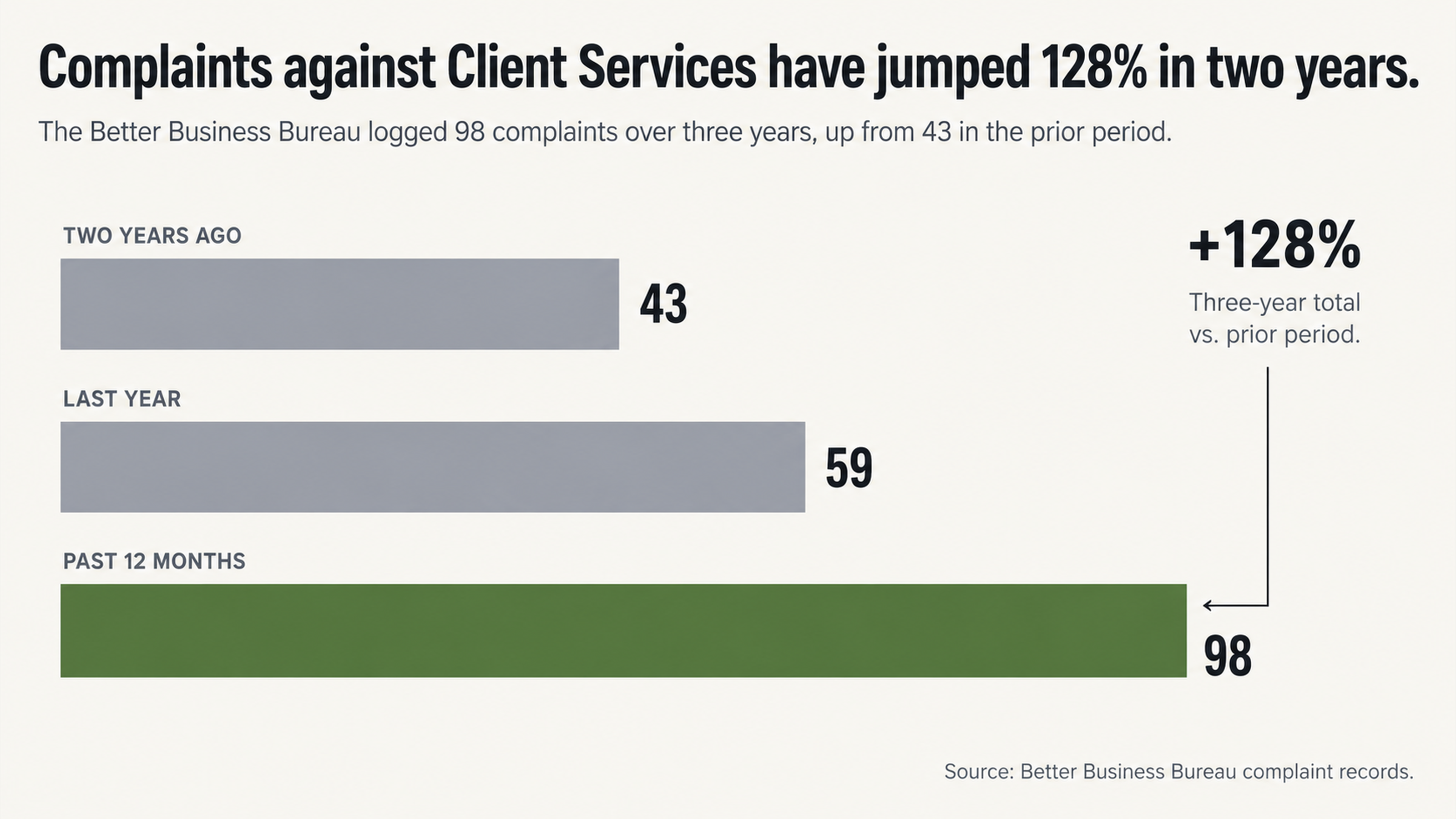
Despite their A+ rating from the Better Business Bureau, there are still a number of complaints that have been filed against Client Services Inc. The Better Business Bureau lists 98 complaints filed against the company in the past three years, with 39 complaints in the past year alone. This represents a 128% increase over the 43 complaints filed two years ago.
Of those 98 complaints, only 23 (or 23.5%) were considered resolved. That means that 76.5% of complaints were responded to but not considered resolved. The typical resolution rate for this type of company is around 27%.
People who have reviewed Client Services Inc. on the BBB website have given the company an average of one out of five stars, with all of the reviews being one-star reviews. One reviewer commented, "How does an A+ rated company with 100% of their reviews being 1-star reviews still manage to have an A+ rating?"
What kind of documentation does Client Services Inc. have to provide?
Any time a collection agency lists a collection account on your credit report, they are claiming that the information is accurate and that they have the documentation to prove it. If they can't provide that documentation, the account can be removed from your credit report. But what kind of documentation are they supposed to have?
Client Services Inc. says they are a third-party debt collector, not a debt buyer. That means they don't actually buy debt from the original creditor but instead collect the debt on behalf of that creditor. That distinction is important, because it means they should have access to all of the documentation related to your debt.
In order to verify a debt, a debt collector should be able to provide the original contract that you signed, a copy of every payment you have made on the debt, documentation of all of the assignments of the debt from the original creditor, and documentation that the debt is yours. If they can't provide any of those things, they don't have the documentation they need to verify the debt.
Keep in mind that collection agencies often care more about placing as many collection calls as possible than they do about the accuracy of the information they are collecting on. That means it's easy for them to make mistakes and mismark accounts. And if they are collecting on thousands of accounts, the likelihood that they will make a mistake on any given account increases.
Does Client Services Inc. have a history of this kind of thing?
If you look at the history of lawsuits filed against Client Services Inc., you can get an idea of whether or not they have a history of violating your rights as a consumer. ClassAction.org lists at least 27 proposed class action lawsuits against Client Services Inc. in 2017 and 2018 alone. Many of those lawsuits were filed under the Fair Debt Collection Practices Act (FDCPA) and the Telephone Consumer Protection Act (TCPA).
For example, the court in the case of Sanchez v. Client Services, Inc., 520 F. Supp. 2d 1149 (N.D. Cal. 2007) found that CSI violated the FDCPA when they placed 54 calls to the plaintiff over the course of six months. Another lawsuit filed in 2009 in U.S. District Court for the Southern District of California found that CSI could be sued under the FDCPA and TCPA for calling the plaintiff as many as three times a day for several weeks because such conduct may be found to be harassment.
Some of the most common allegations against Client Services Inc. under the FDCPA include:
- Failing to clearly state the name of the creditor
- Using misleading or deceptive debt collection letters
- Making false representations about the character, amount, or legal status of the debt
- Disclosing information about the debt to a third party
All of those violations could indicate problems with documentation.
Why you should not pay Client Services Inc. without a fight
If you see a collection account on your credit report from Client Services Inc., you may be tempted to simply pay the debt and make it go away. But before you do that, you should understand how paying a collection account can affect your credit report.
When you pay a collection account, it will be marked as a “paid collection” on your credit report. But that doesn't mean it will disappear. The account will still stay on your credit report for seven years from the original date you missed a payment. That means paying the account doesn't actually help you in any way when it comes to your credit report.
Some people believe that paying a collection account shows that they are taking responsibility for their debts and that it will be looked at favorably by lenders. But the truth is that a paid collection is still a collection. Many credit scoring models don't differentiate between paid and unpaid collections, especially for older credit scoring models used by mortgage lenders.
You should never pay a collection account without first disputing the debt. And if you do decide to pay, make sure you have a written agreement about how the account will be reported on your credit report. You should never rely on the promises of a debt collector without getting them in writing. In fact, it's a good idea to conduct all communication in writing rather than over the phone whenever possible.
What paying a collection account really does
So what does paying a collection account really do? It does one thing for certain: it puts money in the debt collector's pocket. But that's where it ends. Paying a collection account does not:
- Remove the account from your credit report
- Shorten the seven-year period that the account can stay on your report
- Guarantee that the debt collector will properly update the account on your credit report
- Prevent the debt collector from selling the debt to another collection agency
That's why disputing the account is always the best first step. If the dispute is successful, the account will be completely removed from your credit report. If the dispute is not successful, you can still pay the account. But if you pay the account first, you give up your chance to have it disputed and removed.
Supporting Your Dispute: Evidence of a Problem
You can't just say something is wrong. You need to be able to point to specific evidence that supports your dispute and shows there's a problem with the way Client Services has been handling your account.
BBB Complaints as Evidence of a Pattern
Those 98 complaints that Client Services has racked up with the BBB aren't just a warning to other consumers. They're evidence of a pattern or practice that can be used to support a specific dispute.
The types of complaints that have been filed against Client Services are telling. The majority (56.1%) relate to problems with billing and collections. Another 12.2% are complaints about customer service and 9.2% are issues with an order. This pattern points to potential problems with the way the company is handling account information and communicating with consumers.
If you're disputing a debt that Client Services has placed on your credit report, citing this pattern of complaints can help bolster your case. The credit bureaus are required to conduct a reasonable investigation of disputes. Pointing to evidence that there is a pattern or practice of problems at the company furnishing the information can help make the case that there may be a problem with your specific account as well.
Consumer Reviews Highlight Systemic Issues
Reviews from consumers who have dealt with Client Services highlight some systemic issues that could support a dispute. Here's what one consumer said:
"This company must think harassment is a business model because that's all they do. They call me multiple times a day from different phone numbers like I won't notice."
In another review, a consumer describes being contacted about a debt owed by a family member who has passed away:
"This company called me on my cell phone looking for my sister, who passed away 7 years ago and never had this phone number, and when I asked them how they got my cell phone number and/or what kind of company they were, they wouldn't answer those questions but demanded I call them back to discuss my dead sister's debt. I did not."
These consumers point to two big problems — repeated attempts to collect a debt that may not actually belong to the consumer being contacted and a refusal to answer questions about the debt. Both of these are potential violations of the FDCPA and could support a dispute based on a problem with documentation.
The Dispute Process: How to Challenge Client Services in Writing
Challenging a collection account is a paperwork process. The idea is to force the collection agency to provide documentation that shows not only that the debt is legitimate but that it belongs to you and is being reported correctly. If they can't do that, the account has to be deleted.
Challenging the Credit Bureaus
The FCRA gives you the right to dispute any information that you find on your credit reports that you believe is inaccurate, incomplete, or can't be verified. When you file a dispute with the credit bureaus, they are required to investigate and respond within 30 days. They will either verify the information or delete it.
Your dispute should be as specific as possible. Instead of saying, "this isn't my debt," say, for example, "this debt is not mine because the balance is incorrect," or "the date is wrong," or "this account belongs to someone with a similar name," or "I already paid this debt to the original creditor." The more specific you are the better.
Make sure you keep everything in writing. This will help you keep a paper trail of your efforts as well as any failure on the part of the credit bureaus or the collection agency to appropriately respond to your dispute. In the event that you need to file a lawsuit or take further action, having this documentation will be important.
Why You Need a Professional to Help
The debt collection process is complex, and there is an information imbalance that works in favor of the debt collector. The collector understands the rules and the process in a way that the average consumer simply doesn't.
A credit repair professional understands the FCRA and FDCPA and the types of documentation that a collector must provide to verify a debt. The professional will also understand the types of procedural failures that can result in the deletion of an account.
Many consumers who try to navigate the dispute process on their own end up with generic letters and a continuation of the reporting. A professional can help level the playing field and ensure a more favorable outcome.
The Importance of Not Talking to a Debt Collector
Every time you have contact with a debt collector, you are providing that collector with the opportunity to gather more information. One way to protect your interests and prevent a collector from getting information that can hurt your case is to say nothing at all.
What Talking to a Debt Collector Will Cost You
When you get on the phone with a debt collector, you may be inadvertently providing information that the collector needs to pursue the debt. You may, for example, be confirming your address or place of employment if you didn't before. You may acknowledge that a debt is yours even though the collector can't otherwise prove that. You may also be restarting the clock on the statute of limitations simply by acknowledging that you owe the debt.
Client Services has call centers in Missouri, Kansas, and Costa Rica and has between 500-1,000 employees. Consumers have reported being contacted by more than 70 different phone numbers associated with the company. There's a reason that the company is willing to dedicate so many resources to calling consumers — it works.
Refusing to talk to a debt collector is not an attempt to avoid the problem, it's a strategy for protecting your rights and your interests under the law. Everything that you need to communicate can be done in writing, where you maintain control of the narrative and have documentation of every interaction.
Protecting Your Rights with Written Communication
There are a couple of powerful rights under the FDCPA that can be exercised through written communication. You have the right, for example, to request validation of a debt from a collector. The collector must provide documentation to prove that the debt is valid and that it belongs to you. You also have the right to dispute a debt and request verification before the collector can continue to try to collect it.
When you make a written request, you are triggering legal obligations for the collector. When Client Services gets a written request for validation, for example, the company is required to stop all collection activity until it has provided the requested documentation. If the company continues to attempt to collect without validating the debt, that's a violation of the FDCPA.
Every letter that you send should be sent via certified mail with return receipt requested. This will provide documentation that the collector received your letter and help establish a timeline of your communications. If a collector is trying to suggest that it never got your dispute letter, for example, a return receipt will prove otherwise.
The Bottom Line
When Client Services places a collection account on your credit report, the company is making a claim that needs to be proven. Given the company's history of consumer complaints, federal lawsuits, and low rate of resolving disputes in favor of the consumer, there's a good chance that not every claim the company makes will stand up to scrutiny.
The 128% increase in complaints filed with the BBB since 2019, the 27 class action lawsuits that were filed in just two years, and the court's determination that the company violated the FDCPA all suggest that there may be a pattern or practice of errors when it comes to the way Client Services operates. And those errors could be affecting your credit report right now.
If you pay a collection account without disputing it first, you're rewarding whatever pattern or practice produced the error. If you dispute first and pay only when necessary, you're protecting your rights and your credit report. The burden of proof is on the collector, not on you.
What You Can Do
If you have a collection account on your credit report from Client Services, you may have options. The company may not have all of the documentation that it needs to prove the debt. The information may not be entirely accurate. The company's practices may have violated your rights under federal law.
At FightCollections.com, we specialize in challenging collection accounts through the dispute process. We understand what documentation collectors are required to provide and the types of procedural failures that can result in the deletion of an account.
Contact us today to request a free consultation and to learn more about whether we may be able to help you challenge the Client Services collection account that is hurting your credit. You don't have to accept a negative mark on your credit history simply because a debt collector put it there.