

If Credit Control LLC has shown up on your credit report, it is likely that this has been quite a surprise to you.
This debt collection agency out of Missouri has been attempting to collect from consumers since 1989 and has made a presence in all 50 states. Knowing this company is the first part of the battle.
What Do We Know About Credit Control LLC?
One of the best ways to determine how a collection company operates is to look at the data. In 2021, Credit Control LLC was the subject of 143 complaints to the Consumer Financial Protection Bureau (CFPB). This means they are the 216th most complained about company out of all the financial companies that were the subject of a complaint that year.
The CFPB complaint database also shows that there were 166 complaints about Credit Control LLC that were closed in 2016. This means that the issues with this company aren’t recent. They have been going on for at least the last seven years.
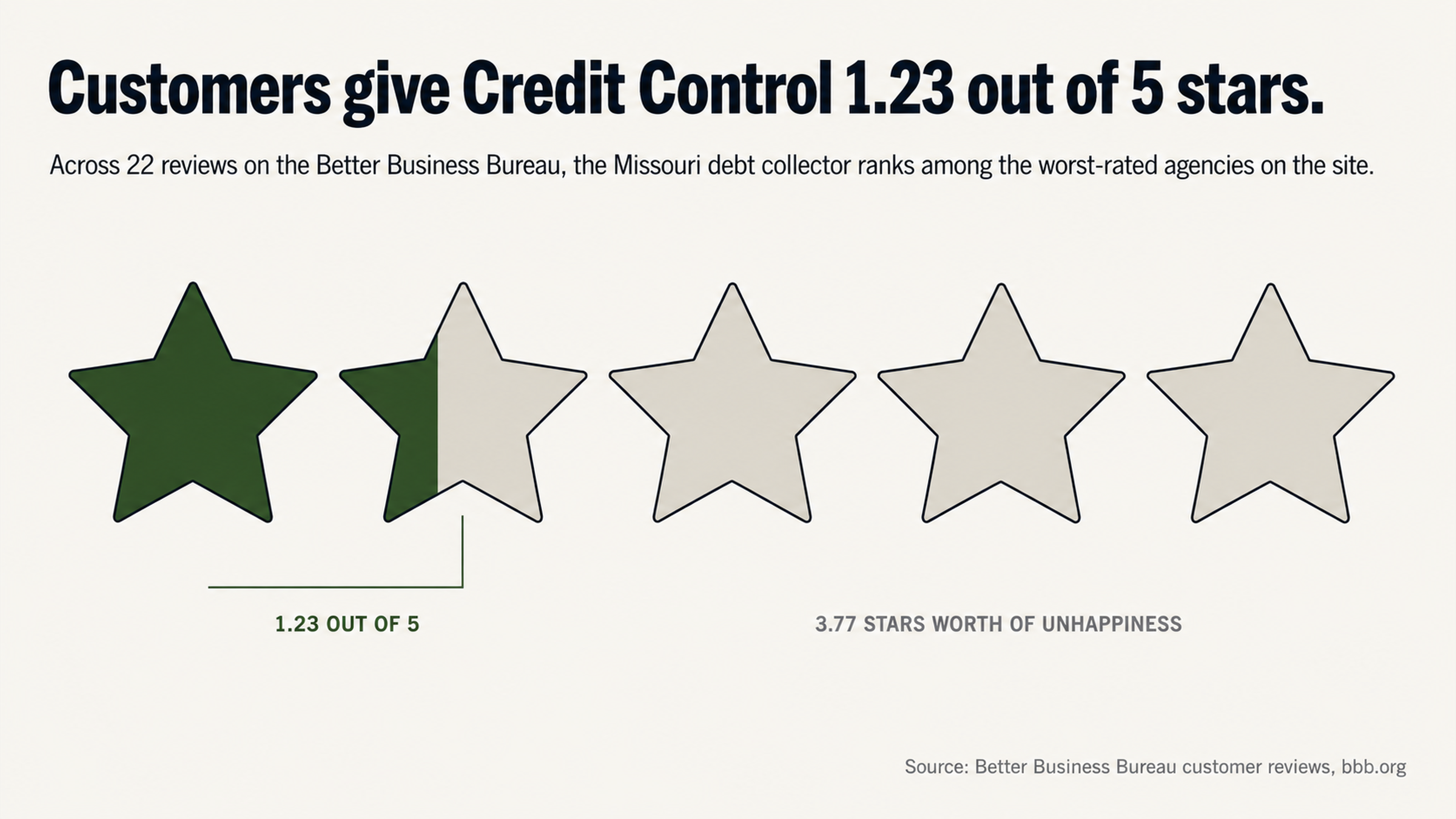
Looking at the Better Business Bureau (BBB) website, we see a similar trend. Credit Control has been a BBB-accredited company since December 2012, but over the last three years, there have been 377 complaints filed against them with the BBB, and over the last year alone, there have been 131 complaints filed. The customer reviews on the site give the company a rating of 1.23 out of 5 stars, based on 22 reviews.
Perhaps the most important thing to note about Credit Control on the BBB site is the consumer alert that the company has a pattern of complaints that have been filed against them for: “Calling consumers to collect debts that the consumer did not owe. Problems getting a copy of the alleged debt from the company. Difficulty contacting the company.” If the BBB has issued a consumer alert about a company, you should definitely take that as a sign of potential trouble.
Who Does Credit Control LLC Collect For?
Credit Control is a third-party debt collector. This means they do not purchase debt from the original creditor but rather collect debts on behalf of the original creditor. The client list on the Credit Control website shows that they work with 13 of the top 15 banks in the country, as well as T-Mobile and Verizon, a few healthcare providers, some utilities, and a couple of educational institutions.
In recent years, the company has grown by acquisition. In July 2015, they acquired Professional Recovery Services and in August 2017, they acquired Regional Adjustment Bureau. While these acquisitions have certainly increased their business, it is also possible that they have increased the potential for errors and incorrect debts being attributed to consumers.
The fact that this is a third-party debt collector also means that their customer is not you, the consumer. Their customer is the bank or original creditor they are collecting for, which is why their customer review rating is so low. The customer rating does not impact their business at all.
How Does Credit Control LLC Collect Debts?
There are a few different ways that Credit Control attempts to collect debts. Looking at the letters they have sent to consumers in the past, we see that they often include a settlement amount and give the consumer an eight-day window to respond to the letter and settle the debt. Allegedly, these letters do not make it clear that consumers have 30 days to request validation of the debt, which is a right provided to consumers under the Fair Debt Collection Practices Act (FDCPA). The company has also been accused of sending letters that fail to identify the current creditor to whom the debt is owed.
On the Credit Control website, there is a consumer complaint from January 2026 that says: “This company harasses you and says they are recording you, but will not let you record them. They are scammers.” There are several other complaints on the site that suggest similar behaviors, so while we do not know for certain what their communication tactics are, there is certainly enough documentation to suggest that there may be a problem.
Credit Control has been the subject of more than 80 federal lawsuits, most of which center around alleged violations of the FDCPA. In 2017, the case of Hart v. Credit Control was heard by the 11th Circuit Court of Appeals. Ultimately, the court ruled that voicemails can be considered communications under the FDCPA if they make it clear the call was from a debt collector. There have been plenty of cases where Credit Control has been found to have violated consumer rights.
How Many Complaints Are There Against Credit Control LLC?
There are a lot of complaints against Credit Control, which is not surprising, considering the documentation that suggests they may be violating consumer rights. On the BBB website, there are 377 complaints over the last three years and 131 over the last year alone. The customer review rating is 1.23 out of 5 stars, based on 22 reviews. The CFPB database shows that there were 143 complaints in 2021 alone, which makes Credit Control the 216th most complained about company in the country.
Of those complaints, 75.6 percent were about billing and collections issues. This means that 285 consumers complained about problems with their bills or issues surrounding the collection of their debts. Another 11.1 percent of complaints were about problems with an order, which totaled 42 complaints. There were 19 complaints, or five percent of the total, about customer service, and 17 complaints, or 4.5 percent of the total, about problems with service or repairs.
In October 2025, a consumer posted this review on the BBB site: “I just received an email from Credit Control stating that I owe them money, which is false. I called the number on the email and they have my email address under someone else’s name. The lady who helped me told me they had three email addresses for the person they were charging and that they would delete mine. This means they send random emails for collections without verifying the information.”
In September 2024, another consumer reported this: “I received a letter stating that I owe for accounts in 2005. I was only 19 in 2005 and did not have any credit. These are not my accounts.”
These are just a couple of examples, but they suggest that the company may not always verify the information for the accounts they are attempting to collect.
Federal Lawsuits Against Credit Control LLC
There have been more than 80 federal lawsuits filed against Credit Control. Many of these center around alleged violations of the FDCPA. For example, in 2020, the case of Bryan v. Credit Control was heard by the Second Circuit Court of Appeals. Ultimately, the court ruled that the collection letter the company sent did not adequately disclose that it was an attempt to collect a debt and did not clearly identify Capital One as the owner of the debt, which was a Kohl’s credit card account.
In 2021, the case of Garcia v. Credit Control was filed. The plaintiff alleged that Credit Control violated the FDCPA provision that prohibits envelope markings by placing a barcode and numbers in a way that they could be seen through the windowed envelope.
A few of the lawsuits filed against Credit Control suggest that the company may have violated provisions of the FDCPA, including:
- Misleading envelope markings.
- Failure to properly disclose identity in voicemails.
- Recording phone calls without consent.
According to the McCarthy Law firm, there have been many consumer complaints about Credit Control that suggest they are violating provisions of the FDCPA, including:
- Failure to provide written verification of the debt.
- Threatening to take actions that the company cannot legally take.
With so many lawsuits against them, it seems that Credit Control may have a real problem.
Why You Should Not Pay A Collection Agency Right Away
It seems intuitive that if you get a collection notice, you should pay what you owe as soon as possible. Unfortunately, that is not always the case. In fact, paying a collection right away is often the worst thing you can do.
When you pay a collection agency, you are confirming that the debt is valid and belongs to you. Once you have made a payment, you have lost all your leverage, and there is nothing you can do to get the account removed from your credit report. If you don’t pay, the status of the account will still say “unpaid collection,” but if you do pay, the status will be updated to “paid collection.” In either case, the account remains on your credit report, so either way, you have not accomplished anything in terms of getting it removed.
Additionally, the credit reporting agencies all have different policies about how paid collections are treated, so it is difficult to say for sure what the impact will be. For all these reasons, it is never a good idea to pay a collection account without first validating the debt and determining whether or not it is worth paying.
How Do I Get Credit Control LLC Off My Credit Report?
If Credit Control is on your credit report, your first step should always be to dispute the account. This is true whether you believe the account is valid or not. Federal law says that a collection account can be removed from your credit report if the information is inaccurate, erroneous, or fraudulent or if the credit reporting agency cannot verify the information within a reasonable amount of time.
There have been enough complaints about Credit Control that suggest they are not always verifying information before attempting to collect, so it is worth it to file a dispute, regardless. The dispute process can be a little confusing if you have not been through it before, but essentially what happens is that you will file a dispute with the credit reporting agency, and then they will contact Credit Control to verify the information. If Credit Control cannot do so, the account must be removed from your report.
You should never attempt to contact Credit Control directly to dispute an account. Any time you communicate with a collection agency directly, there is the risk that you will say something that can be used against you or that you will inadvertently acknowledge that the debt is valid or waive other rights you have as a consumer. The dispute process is in place to protect you from this. Never attempt to go around it.
Is It Worth It To Hire A Professional?
There are a few reasons why you may want to consider hiring a professional to help you deal with a collection agency. First, the collection industry is designed to be intentionally one-sided. The collector has all the information, and the consumer has none. This is why so many consumers end up in bad situations when dealing with collection agencies. If you hire a professional, you have someone on your side who knows how to navigate the system and level the playing field.
Second, professionals will review the collection account to determine if there are any inaccuracies or if there are other potential issues that can be raised as part of your dispute. There are plenty of consumers who will never know to raise these issues on their own.
Finally, when you hire a professional, you do not have to deal directly with the collection agency yourself. This is important because many collection agencies will stop at nothing to attempt to get you to pay a debt. This can include harassment and other behaviors that border on abusive.
Protecting Your Rights Going Forward
As we have already suggested, your first step in dealing with any collection agency should always be to educate yourself on your rights as a consumer. The FDCPA is a federal law that provides plenty of protections for consumers, but you must know how to use them in your favor. Some of the rights you have as a consumer under the FDCPA include:
- The right to request validation of a debt within 30 days of the initial contact from a collection agency.
- The right to dispute inaccurate information on your credit report.
- The right to request that a collection agency cease communication with you.
There are plenty of documented cases where Credit Control has sent letters to consumers with eight-day deadlines for responding and settling debts. There is no law that suggests you must respond to a collection letter within eight days, so if you receive such a letter, you should be aware that this is a tactic the collection agency is using to attempt to force you to pay a debt.
It is also important that you monitor your credit report regularly, so you are aware of any potential issues as soon as they arise. Under federal law, you are entitled to one free credit report from each of the three major credit reporting agencies each year. You should take advantage of this and check your report at least once a year. If you see anything you do not recognize or that you believe is an error, document everything and begin the dispute process as soon as possible.
If you find that there is a Credit Control account on your credit report that you do not recognize, document the date you found it, all the information you can find about the account, and any discrepancies you notice. This information will be helpful if you need it as you begin the dispute process or if you pursue any FDCPA claims against the company.
The Bottom Line
The next time you receive a collection notice, do not panic. There are steps you can take to protect yourself and your credit report. Just remember that it is always in your best interest to dispute first and avoid contacting the collection agency directly. If necessary, don’t be afraid to hire a professional.
At FightCollections.com, we specialize in fighting collection agencies like Credit Control. We will review your credit report and evaluate your situation before working with you to determine the best course of action. Do not let a collection agency push you around. Contact us today for a free consultation.