

You pulled up your credit report to find a new account you didn’t recognize… an account from D2 Management. You’re likely panicking, trying to figure out how this happened and what this will mean for your credit.
Don’t worry, we can help, but you need to understand the right approach to use to resolve the issue. D2 Management, LLC is a third-party debt collection agency based in South Carolina. Here is a little information about them:
You probably assume the phone number listed for D2 Management is there so you can call them to pay off the debt they’re claiming you owe. The reality is they only give you the phone number so you can call and ask for written validation of the debt you owe. We will discuss this in detail in just a moment.
What’s Showing Up On Their Record
D2 Management is primarily a debt collector for payday lenders and subprime creditors. They are confirmed to have creditor relationships with Ace Cash Express, Speedy Cash, Cash Central, World Finance, and Personify Financial. They also work with retailers such as HSN and a variety of debt buyers.
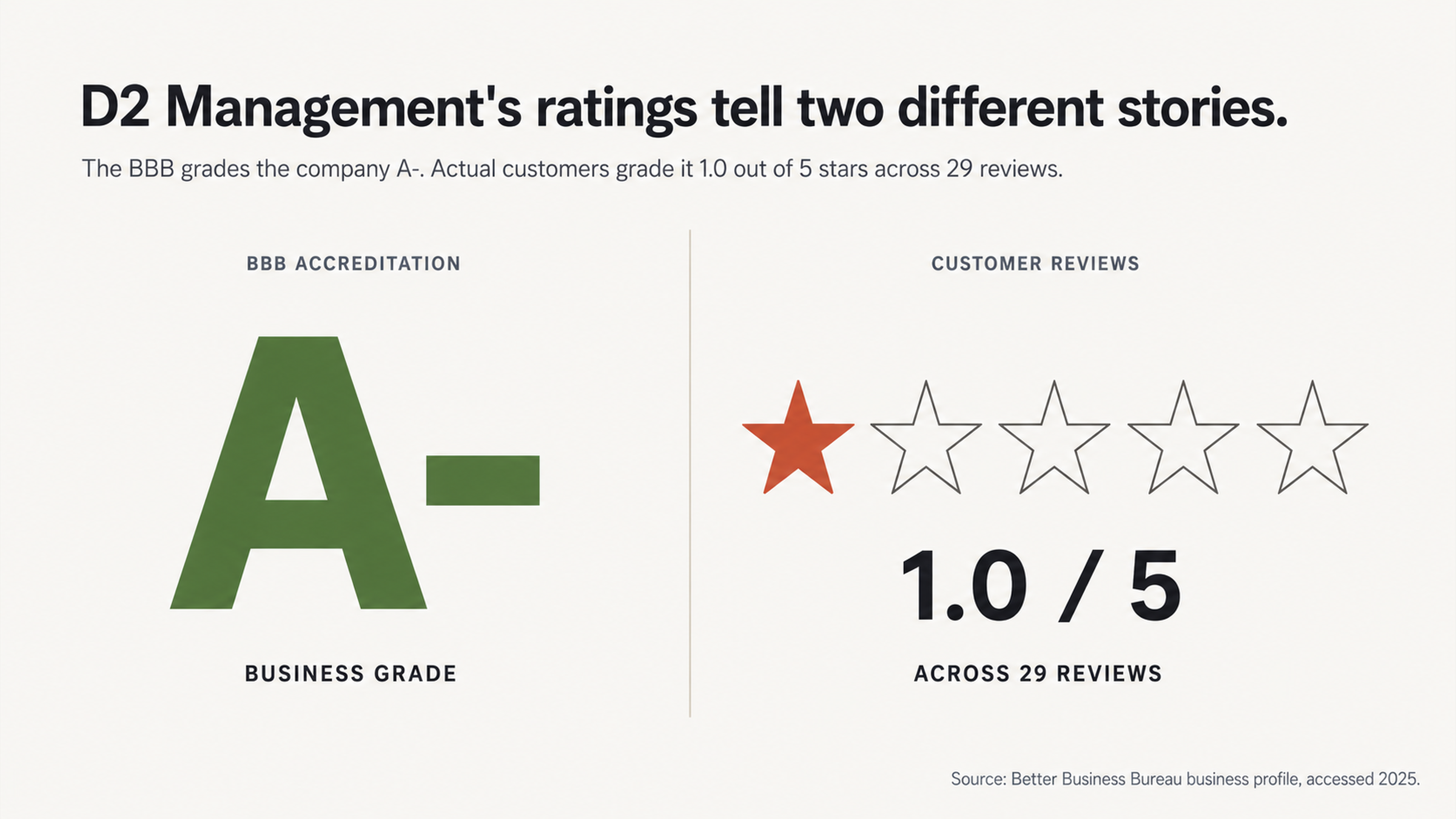
They have registered over 145 complaints from consumers through the Consumer Financial Protection Bureau’s (CFPB) website and the Better Business Bureau (BBB) website. While they are BBB-accredited with an A- rating, their average rating from actual customers is only 1/5 stars (across 29 reviews). The contrast between the rating the BBB gives the company and what actual customers say about them should be your first clue on how to handle the company.
What’s more telling is that in 2019, D2 Management chose not to respond to an FDCPA lawsuit in an Ohio federal court, which resulted in a default judgment against them for $2,806.80; [Poskovic v. D2 Management, LLC; Case No. 3: 19-cv-1286]. If a debt collection company doesn’t even respond to allegations that they’ve violated the Fair Debt Collection Practices Act, that tells you a lot about how they operate their business and view their need to follow the law.
Why Paying D2 Management Is Not Your Best Move
The Trap Most Consumers Fall Into When Dealing with Debt Collectors
Your initial reaction to seeing D2 Management on your credit report is probably to pay off the debt so it goes away. Unfortunately, that’s the exact wrong thing for you to do in this situation.
When you pay off a collection account, it doesn’t actually disappear. Instead, it shows up on your report as a paid collection. That negative account will still be viewable on your credit report by every future lender, landlord, and employer who evaluates your credit over the next seven years from the original delinquency date. You paid them money, but you really didn’t gain anything by doing so.
This is one of the ways debt collectors manipulate consumers into making payments when they aren’t sure if the debts are legitimate. If you are concerned about an impending credit check for a job or a mortgage application, you might be more prone to making rash decisions. That’s exactly what D2 Management is counting on.
The following is what one customer stated about her experience with the company; “I set up payments with this company just to find out what they’re saying I owed and to who I owed was a lie. I unfortunately paid out $935 because there was a debt that I owed. I called to verify I was done with those payments after 9 months and that’s when I was told I owe $1800 which is 100% incorrect. The woman yelled at me and threatened me with action over the phone.”
Keep in mind, the balance she owed practically doubled after she had paid them money for nine months. That isn’t a coincidence; it’s an example of how messy things can get when you’re working with a collection agency that has purchased debt from someone else.
What They Don’t Want You to Understand
The Information Gap Between Collectors and Consumers
Debt collectors have far more information about you than you have about them. They have detailed files about you and the debts you owe, including information about the original account, your payment history, and other personal information that they received from the original creditor or a third-party provider.
Unfortunately, you don’t have any information about D2 Management. You can’t even verify the creditors that the company works with because that information isn’t publicly available. Debt collectors don’t list the companies they work with and those relationships change all the time as debts are bought and sold. They want it this way.
A study by U.S. PIRG found that 79 percent of credit reports have errors or inaccuracies on them. That means nearly 80 percent of credit reports contain something that shouldn’t be there. It could be an incorrect balance, an incorrect date, someone else’s account information entirely, or a debt that is no longer within the statute of limitations.
The Secret to Successfully Disputing the Account
Why You Should Dispute Before You Pay
Instead of immediately paying off the debt you should dispute the collection account. This isn’t about trying to get out of paying a debt you owe; it’s about making the collection agency prove they have a legitimate reason to collect money from you.
When you dispute a collection account with the credit bureaus, they have 30 days to verify the account information. If they can’t, they have to remove it from your report. Unfortunately, many collection agencies don’t have the documentation necessary to verify accounts they’re collecting, especially if they bought the debt. They might have a spreadsheet with names, account numbers, and balances, but they don’t have the full account records.
Here’s how their lack of response can benefit you; once you dispute the account and it’s removed, in most cases, the collection agency doesn’t have the ability or the desire to put the account back on your report. By disputing the account, you might permanently remove it from your report. Compare that with simply making a payment; as we already discussed, paying the account doesn’t remove it. Instead, it shows up as a paid collection for seven years.
Their Validation Issues
There have been several complaints filed against D2 Management for issues related to validating debts. Many consumers claim the company is demanding payment without providing written verification of the debt. The following complaint was filed against them in September 2025; “This company called me and started calling my personal references within 2 minutes of speaking with me. They never sent any written verification.”
The company primarily collects debts from payday loans, many of which are five to ten years old. Those debts may not have the proper chain-of-title documentation, which means the collector may not have the right to collect. However, if the consumer doesn’t recognize that, they may still make a payment.
In its response to a complaint on the BBB website, the company stated they do not report to the credit bureaus. Instead, the original creditor or debt buyer handles credit reporting. This could create another issue with validation because the original creditor and the debt buyer both need to maintain accurate records or the consumer may successfully dispute the account.
How to Avoid Getting Played by Collection Agencies
Don’t Fall for Their Pressure Tactics
Collection agencies use urgency because it works. It’s harder to rationalize your way through a situation when someone is breathing down your neck for money. When a D2 Management representative threatens you with immediate action if you don’t pay today, that’s a tactic meant to get you to react impulsively, not a statement of fact.
The following is what one consumer said about her experience with the company; “I set up payments with this company just to find out what they’re saying I owed and to who I owed was a lie. I unfortunately paid out $935 because there was a debt that I owed. I called to verify I was done with those payments after 9 months and that’s when I was told I owe $1800 which is 100% incorrect. The woman yelled at me and threatened me with action over the phone.”
As we mentioned earlier, the fact that her balance skyrocketed after nine months of payments isn’t a coincidence; it’s an example of the disorganization that plagues the debt collection industry, particularly when it comes to purchased debts. You can’t trust what they tell you over the phone.
Understanding Your Rights
What the Law Says About Your Protection
You have more rights than you realize when it comes to collection agencies. For example, did you know that wage garnishment comes with a list of exemptions that protect much of your income? Most states prohibit creditors from garnishing Social Security benefits, certain types of pensions, and a significant portion of your wages. You’re more protected than you think.
The Fair Debt Collection Practices Act (FDCPA) prohibits collectors from harassing you, lying to you, or otherwise engaging in unfair practices. D2 Management has faced several federal lawsuits over alleged violations of the FDCPA. In fact, an internal review from an employee on Indeed said the following: “The way they want you to collect seems to go against the FDCA.”
When a collection agency’s own employees question whether its collection practices comply with federal law, that should inform how you choose to deal with them.
You have the right to written validation of a debt. You have the right to dispute information you believe is inaccurate. You have the right to not be harassed. Use those rights instead of caving to threats.
Why You Need Help
What Happens When You Try to Go Alone
You can dispute credit reporting errors yourself. The credit bureaus offer online portals for filing a dispute, and they accept disputes by mail. However, this is what you need to understand; when you file a dispute as an individual, collection agencies respond differently than when the dispute comes from a professional credit repair company.
Credit repair professionals understand the technical nuances of the process that provide leverage. They know which types of documentation to request that are most likely to uncover a validation issue. They understand how to escalate a dispute if the credit bureau mishandles it the first time. That knowledge comes from handling thousands of cases, not from reading a few articles online.
Collection agencies work on razor-thin margins and prefer to resolve issues quickly. When they receive a well-drafted dispute from a professional credit repair company that clearly understands their obligations under the FCRA and FDCPA, suddenly the math changes. It may cost more to fight the dispute than to delete the account.
What the Pros Will Catch That You Won’t
A credit repair expert will recognize issues that you won’t. Is the date of first delinquency correct? Is the balance reported consistently across all three bureaus? Is the account being reported by an entity with the legitimate right to report it? Are there duplicate accounts from both the original creditor and the collection agency?
Those kinds of technicalities matter in a credit dispute. A single inconsistency in reporting can be enough to warrant deletion. A professional set of eyes will catch things that an untrained set of eyes misses, and in the credit repair industry, the devil is truly in the details.
Consider the complexity of how D2 Management reports. They don’t report directly to the credit bureaus; instead, that’s handled by the original creditor or debt buyer. Every time the account changes hands, there’s another opportunity for someone to make a mistake. Every mistake is another opportunity to successfully dispute the account.
The objective here isn’t to dodge a legitimate debt; the objective is to make sure that nothing appears on your credit report unless it’s both accurate and verifiable. Given that nearly 80 percent of credit reports contain errors, the odds are in your favor that there’s something on your report that shouldn’t be there.
Stop Enabling Their Behavior
D2 Management, like all debt collectors, relies on consumers who panic, pay the debt without asking questions, and don’t understand their rights. They make money off consumers who are too trusting of verbal threats and too quick to hand over their money. Don’t be that consumer.
A collection account that can’t be verified doesn’t belong on your credit report. The burden of proof is on the collector, not on you. Make them prove it.
Here’s how one customer concluded her review of the company; “The worst experience with a debt collector I ever had. I’m sorry for anyone that has to interact with D2 Management. If you search D2 Management, it states they are known to be rude and aggressive. It’s a shame a company can act like this and still operate.”
You don’t have to accept that kind of treatment or that outcome.
What to Do Next
Don’t Call to Negotiate
If you see D2 Management on your credit report, don’t call them to negotiate a payment. Don’t commit to a payment plan over the phone based on what they claim you owe. Don’t let them use artificial urgency to coerce you into decisions that serve their interests instead of yours.
Get a professional analysis of your credit report. Identify every inaccuracy, every inconsistency, and every unverifiable claim. Then, dispute that information strategically with people who do this for a living and know exactly how to maximize your odds of getting it removed.
The debt collection industry thrives on consumers’ lack of knowledge. Your greatest defense is refusing to play dumb. Your second greatest defense is partnering with experts who know how to turn the collector’s documentation deficiencies into your pathway to a cleaner report.
Contact us at FightCollections.com today for a free analysis of your credit report. We’ll assess what D2 Management is reporting and every potential angle for removal. You have options you don’t even know about yet. It’s time to learn what those options are.