

Do you have a collection account on your credit report from First Source Advantage? If so, it’s probably like someone you don’t know and don’t want has just moved in uninvited and taken over your life.
Fortunately, you have specific legal rights that protect you when dealing with debt collectors. These rights give you the power to challenge this company’s collection and even possibly get the collection removed from your credit report.
In this article, we will cover who First Source Advantage is, their history, and most importantly what you can do about the collection on your credit report. Are you ready to get started?
United States Public Interest Research Groups (U.S. PIRGs) report that 79% of credit reports contain errors or disputes. This means there’s a high likelihood that the collection account on your credit report from First Source Advantage is also a mistake. Before you pay anything to First Source Advantage or speak with a representative from the company, you need to understand your rights.
This article will walk you through who First Source Advantage is, their background, and what you can do to get their collection removed from your credit report.
Who is First Source Advantage?
First Source Advantage, LLC is a third-party debt collection agency with their headquarters located at 205 Bryant Woods South, Amherst, NY 14228-3609. First Source Advantage was founded on April 27, 1995, and has been in the debt collections business for approximately 30 years. They are a subsidiary of the publicly traded corporation Firstsource Solutions Limited with headquarters in Mumbai, India. Here’s their identifying information:
First Source Advantage is a debt collection agency that works with several large creditors to collect debts including: Capital One, American Express, Bank of America, and Driveway Finance Corporation. They collect many different types of debt including credit cards, auto loans, student loans, medical bills, and personal loans.
What does the data show about First Source Advantage?
There is a lot that can be learned about a debt collection agency by reviewing their history and data. Here are a few of the things we found when researching First Source Advantage:
How many lawsuits has First Source Advantage been a part of?
According to the PACER (Public Access to Court Electronic Records), First Source Advantage has been a part of at least 329 federal lawsuits.
Has First Source Advantage been investigated or sued by any government entities?
Yes, the Consumer Financial Protection Bureau (CFPB) issued a Civil Investigative Demand to First Source Advantage in September 2017. The purpose of the CID was to investigate potential violations of the Fair Debt Collection Practices Act (FDCPA) and the Consumer Financial Protection Act of 2010 (CFPA). The areas of investigation included:
- Call recordings
- Settlement negotiations
- Policies and procedures for handling complaints
The CFPB regulates debt collection agencies like First Source Advantage.
What do consumer complaint data show about First Source Advantage?
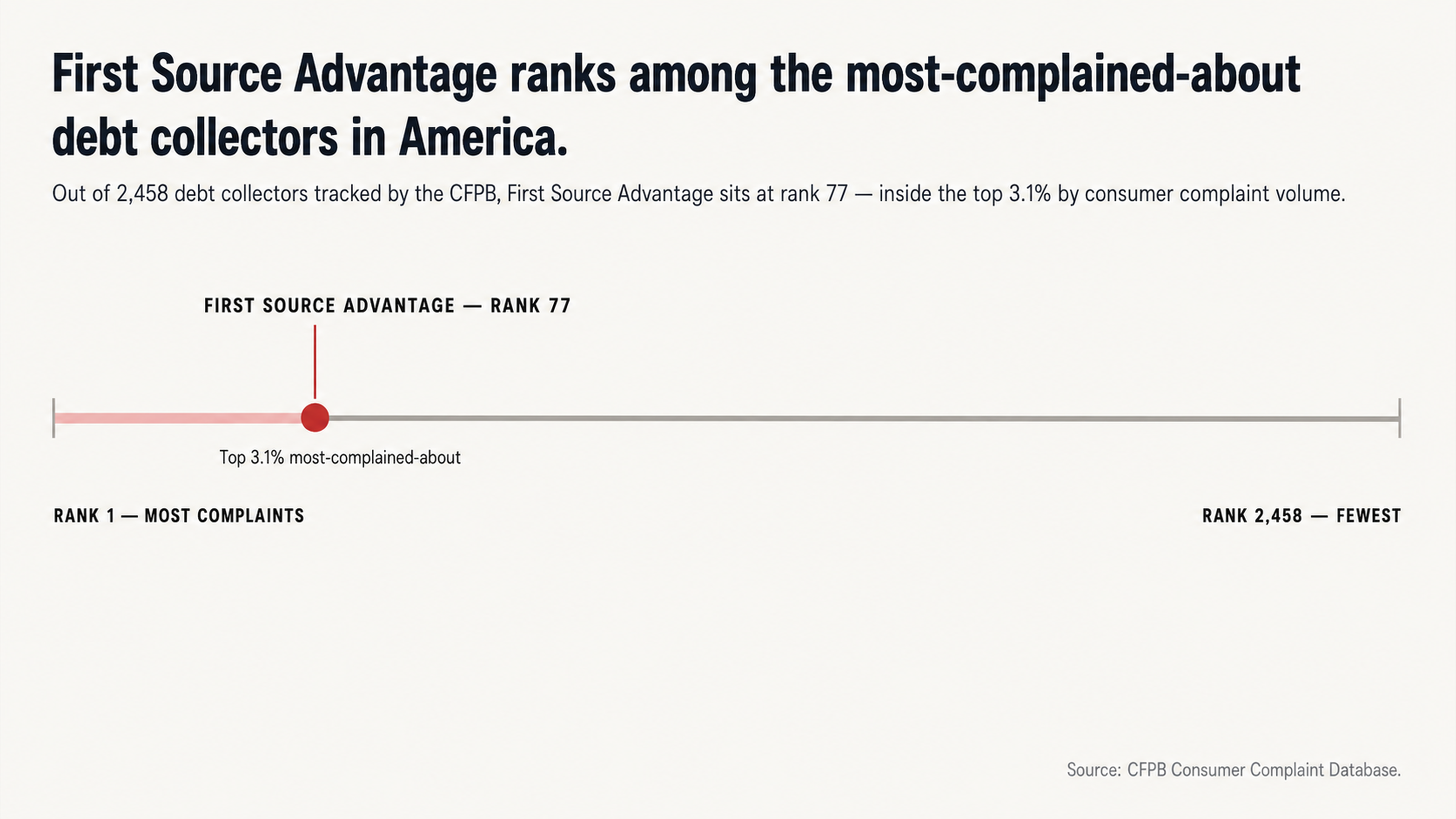
Based on our analysis of the complaint data from the CFPB, First Source Advantage ranks 77 out of 2,458 for the number of consumer complaints. This places First Source Advantage in the top 3.1% of the most complained about debt collectors in the country. The Better Business Bureau reports that there have been 91 complaints against First Source Advantage in the last three years. 85 of the complaints were for problems with their billing and collections.
What are my rights under federal law?
The FDCPA
The FDCPA is a federal law that gives you rights and protections when dealing with debt collectors like First Source Advantage. Some of the rights you have under the FDCPA include:
The right to request written validation of the debt
Under the FDCPA, you have the right to request written validation of any debt a collection agency is trying to collect from you. When you request validation, the collection agency must stop all collection activity until they have provided you the written validation.
The right to dispute the debt
You also have the right to dispute the debt within 30 days of initial contact. When you dispute the debt in writing, the collection agency cannot attempt to collect the debt until the debt has been verified and you have been provided the verification.
The right to damages from violating collectors
Debt collectors who violate the FDCPA may be held liable for statutory damages to the consumer. Many attorneys who practice consumer law offer free consultations and when hired to handle FDCPA cases, may take them on a contingency basis meaning the attorney only gets paid if the consumer wins. The FDCPA states that if you win your case, you are entitled to reasonable attorney fees. This is why many attorneys will take on FDCPA cases without requiring the consumer to pay out-of-pocket for their services.
The right to debt validation
Debt validation is one of the most powerful tools you have when dealing with collection accounts on your credit report. When you request validation, the collection agency must provide you with documentation that proves three things:
- The debt is yours
- The amount of the debt is accurate
- The agency collecting the debt has the right to collect the debt
In many cases, collection agencies are unable to validate the debt because they don’t have the proper documentation. When an original creditor sells a debt to a collection agency, the original account documentation may get lost or corrupted during the transfer process. Collection agencies also may not share information about which original creditors they buy debt from. This information changes constantly as debt is bought and sold.
By requesting validation, you are able to find the weak link in the chain of documentation which may require the collection agency to remove the account from your credit report.
Common complaints and violations
Common complaints against First Source Advantage include:
Harassment
Many consumers report that First Source Advantage harasses them by calling excessively.
In a federal court case, Moore v. Firstsource Advantage, the plaintiff alleged that the company placed over 30 calls in a six-month period with the intent to annoy, abuse, and harass. They also alleged that the company used an automated dialing system and prerecorded messages.
One consumer complaint to the CFPB states: “This company calls me all the time. Two, three times a day. I have now spoken to a representative not once, not twice, not three times, but FOUR TIMES, to tell them that I am not the person they are trying to reach.”
Another complaint filed with the BBB says: “THEY CALL ME MULTIPLE TIMES EVERY FLIPPING DAY. I AM TIRED OF BEING HARASSED BECAUSE THEIR WEBSITE DOES NOT WORK.”
Contacting third parties and family members
The FDCPA has specific rules about when and how debt collectors can contact third parties and family members. Despite this, we found several complaints that First Source Advantage contacted family members.
In one complaint, the consumer reports: “They have called my brother 3 times, and my parents, who are elderly and in a different state, 6 times now. They made contact with my father and said, ‘Don’t you care what your son is doing to his credit.’”
In another complaint, the consumer says: “They called my brother-in-law at home and at work and threatened a lien on their home even though they had nothing to do with our debt and had no right to any information about it.”
Attempting to collect debts not owed
We found several complaints that First Source Advantage attempted to collect debts that consumers say they do not owe.
One consumer states: “I received an actual bill from these clowns for a First Premier Bank Card I never had. I called First Premier. They confirmed they did not refer any accounts to these people, the account number on the bill is not mine, and the balance they are claiming I owe is not my debt.”
Another consumer reports being contacted about an old debt: “I asked several times what date this goes back to. He finally says the date. Which was 11 or 12 years old. I explained that I did not owe anything. There is a statute of limitation and they are WAY over. He said they could still collect on the debt.”
Why you should dispute before you pay
Don’t fall into the trap of thinking that paying a collection account is going to make it go away. When you pay a collection, you are simply changing the status of the account from unpaid to paid. The account will remain on your credit report for seven years from the original delinquency date.
Paying a collection account may actually harm your credit score. Although newer credit scoring models are not as heavily impacted by paid collections, this is not true of all scoring models. A paid collection is still an indication to the credit bureaus that you had trouble paying your debts on time.
If you pay a debt, it can also reset the statute of limitations on old debts. In some states, making a payment on an old debt can revive it and once again make it within the statute of limitations for a lawsuit. A payment may also be considered by a judge or jury as an admission that you owe the debt. This could eliminate any defense you may have to the debt.
The power of sending a validation request
When you dispute a collection and request validation, you are putting the burden of proof on the collection agency. They must provide you with documentation that proves the debt is valid, the right amount, and that they have the legal right to collect it. Many collection agencies don’t have the documentation to meet these burdens.
It is possible to get collections removed from your credit report if they contain any information that is inaccurate, erroneous, or fraudulent. You can also request removal if the credit reporting agency or the collection agency cannot verify the information within a reasonable amount of time. Instead of paying money to change the status of a collection account from unpaid to paid, disputing a collection seeks removal of the entire tradeline.
Most debts aren’t worth the collection agency’s time or money to pursue. Before spending the time and money to pursue your debt, they perform a cost-benefit analysis. If you make it clear that you will not pay without proper validation and will dispute any inaccuracies, they may decide that your debt isn’t worth their time or money and move on to easier targets.
How to take control of your financial identity
Why you need professional help
The debt collection industry is an industry that has a knowledge gap. The collection agencies know the laws and the loopholes and use urgency and fear to pressure consumers to make immediate payments without validating the debt. They count on consumers not understanding their rights or challenging their authority.
When you work with professionals who understand the laws surrounding debt collection, you begin to level the playing field. A professional credit repair expert understands what documentation a collection agency must provide to validate a debt. They understand when a debt collector has violated your rights and how to file the proper disputes to increase the odds that the collection agency will be required to remove the account from your credit report.
Most credit repair experts offer a free consultation and case review. During the review, they will be able to help you understand your situation and what options you have. They can also help you understand what your rights are and what the likelihood of success will be. The review requires no commitment from you but will give you the information you need to make informed decisions about how to handle the collection account on your credit report.
Building financial sovereignty
Getting a collection removed from your credit report isn’t just about improving your credit score, it’s about taking control of your financial identity and refusing to be controlled or manipulated by collection agencies who may not have the proper documentation to collect the debt.
Financial sovereignty is about understanding your rights and using them effectively. It’s about building a credit report that accurately reflects your creditworthiness and making informed decisions instead of reactive decisions based on fear or misinformation.
Once you have corrected your credit report and removed any inaccurate or unverifiable information, you can focus on building positive credit and preventing future problems. It’s always easier to prevent a problem than correct one, but when there is a problem you have to take care of before you can move forward.
Conclusion
First Source Advantage has been sued in federal court at least 329 times, has been the subject of a CFPB investigation, and ranks in the top 3% of debt collectors in the country for the number of consumer complaints. Their business practices include excessive calling, contacting family members, and attempting to collect debts from consumers who say they do not owe them.
If you have a collection account on your credit report from First Source Advantage, you don’t have to just pay it and hope for the best. You have options. Federal law provides you with very specific rights when dealing with debt collectors. You have the right to validation, the right to dispute, and the right to not be harassed.
What do you do next?
It’s time to take the first step toward reclaiming your financial identity. At FightCollections.com, we offer free consultations and case reviews. Our experts will help you understand your situation and your options and help you make informed decisions about how to proceed. Contact us today to get started.