

Seeing a new Harrison Harris Limited collection account on your credit report might feel akin to coming home and finding someone has moved into your house uninvited.
But if Harrison Harris Limited is the debt collector, there’s something they don’t want you to know about.
Harrison Harris Limited is an assumed name used by Harris and Harris, Ltd., a Chicago-based debt collection agency with decades of experience. They carry a history of regulatory actions and consumer complaints that most people are unaware of.
In this article, you’ll learn how Harrison Harris Limited collection accounts might be easier to remove from your credit report than you think. First, let’s take a look at what Harrison Harris Limited actually is.
What is Harrison Harris Limited?
Harrison Harris Limited is an assumed name used by a debt collection company, but the name itself is not registered as a debt collection agency. Our searches of the UK Companies House, FCA Financial Services Register, and U.S. state licensing databases did not find any matches for the Harrison Harris Limited name. That suggests Harrison Harris Limited is actually Harris and Harris, Ltd., a Chicago-based debt collector that has been in business since 1968.
It is not uncommon for debt collection agencies to use assumed names like Harrison Harris Limited, which can cause confusion for consumers who are trying to research a debt collector or verify a collection attempt.
The Consumer Financial Protection Bureau received over 1,800 complaints about Harris and Harris in the past year alone.
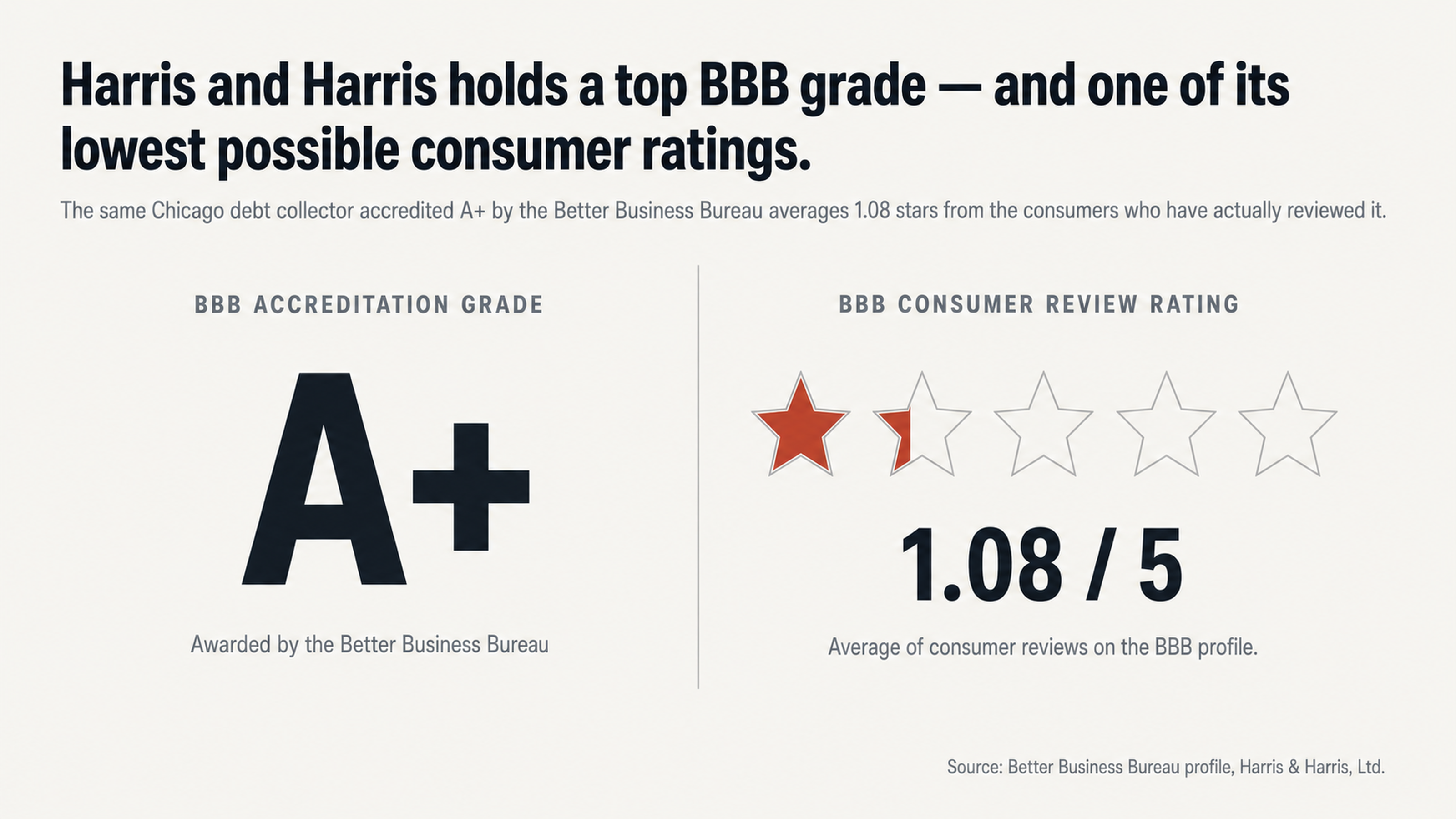
The Better Business Bureau reports 957 complaints filed against Harris and Harris in the past three years, with 601 of those coming in the past year, suggesting the frequency of complaints against the company is increasing. The BBB also shows a 1.08 out of 5-star rating from consumer reviews, which is one of the lowest possible ratings, despite the company’s A-plus accreditation.
In February 2024, Washington State Attorney General Bob Ferguson announced a settlement with Harris and Harris for $1 million after the company sent 294,652 collection notices to 166,872 patients that failed to include required disclosures about patient rights.
Federal court records show at least 16 complaints filed against Harris and Harris for alleged violations of the Fair Debt Collection Practices Act. In the 2011 Seventh Circuit case Kasalo v. Harris and Harris, Ltd., the parties stipulated that Harris and Harris violated the FDCPA and the court awarded statutory damages to the plaintiff.
Why Harrison Harris Limited Collection Accounts May Be Easier to Remove Than You Think
A U.S. Public Interest Research Group study found that 79 percent of credit reports contain errors or other mistakes. That fact alone should dramatically change the way you approach a collection account on your credit report. Instead of assuming the information is correct and you owe the debt, you should now assume the information requires verification.
Harrison Harris Limited collection accounts have passed through at least two sets of hands before they appeared on your credit report. The original creditor transferred the information to Harris and Harris, which then reported it to the credit bureau. Each of those data transfers creates opportunities for errors in the account number, balance, date, and even the name of the alleged debtor.
We found at least one example of that type of error in a Better Business Bureau review of Harris and Harris. The reviewer reported that the company was trying to collect a debt from her that actually belonged to another person with the same name but a different address and date of birth. She said she contacted the original creditor, which confirmed that the debt belonged to the other person, but Harris and Harris continued to try to collect the debt.
Verification Issues
Another reason collection accounts may be easier to remove than you think is that debt collectors frequently lack the documentation they need to verify the debts they’re trying to collect. Under the Fair Debt Collection Practices Act, you have the right to request verification of a debt within 30 days after the debt collector first contacts you. Once you make that request, the debt collector must stop trying to collect the debt until it provides the verification you requested.
We found several complaints about Harris and Harris that suggest the company may have a problem verifying the debts it’s trying to collect. One consumer filed a complaint with the Consumer Financial Protection Bureau and reported that she filed an online dispute and provided documentation that showed she paid the debt with a credit card statement. Harris and Harris responded by saying the original creditor confirmed that she still owed the debt. When she contacted the original creditor, it confirmed that she didn’t owe the debt.
Other consumers have reported similar problems with Harris and Harris. That’s not unique to Harris and Harris. We’ve found many debt collectors that appear to have difficulty verifying the debts they’re trying to collect.
Don’t Fall for Manufactured Urgency
When debt collectors call or send letters, they typically try to create a sense of urgency to get you to make a payment as soon as possible. In many cases, that urgency is unnecessary. There usually is no valid reason why a debt that may have been sitting for months or years suddenly demands immediate attention.
Debt collectors create a sense of urgency because it works. When you’re under stress about a debt, you’re more likely to make a payment you may not owe or agree to a payment plan you can’t afford. You’re more likely to respond to urgency because you want to make the calls and letters stop. You want to avoid a potential lawsuit. You just want to get it over with.
The best way to respond to manufactured urgency from a debt collector is by ignoring it. You do not have to talk to a debt collector on the phone. You do not have to respond to a letter. Every minute you spend researching, calling, and deciding is another minute you’re not giving in to the urgency a debt collector is trying to create.
Why Paying May Not Help Your Credit Score
One reason debt collectors don’t like to talk about urgency is that paying a collection account only results in a change in status from “unpaid collection” to “paid collection.” The account remains on your credit report and will continue to affect your credit score for up to seven years from the original delinquency date. That means writing a check may not resolve a credit issue. It may only change a collection from unpaid to paid.
If you settle a debt for less than the full amount, the outcome is less predictable. It depends on how the creditor reports the settlement, your current credit history, and many other factors. In some cases, a settlement may only improve your credit score a little. In other cases, it may make things worse.
That’s one reason we recommend a dispute-first approach to collection accounts on your credit report. When you’re able to get an account removed, it will no longer affect your credit score at all. Debt collectors do not want you to know that because it undermines their entire business model.
Your Rights Under the Fair Debt Collection Practices Act
The Fair Debt Collection Practices Act is a federal law that prohibits debt collectors from engaging in unfair, deceptive, or abusive collection practices. You should memorize some of the most important protections in the FDCPA because debt collectors may not want to talk about them.
Debt collectors may not call you before 8:00 AM or after 9:00 PM. They may not contact you at work if you’ve told them your employer prohibits such contacts. They may not use profanity or threaten or use abusive language. They may not make false statements or claims. They may not threaten to take actions they cannot legally take or are not intending to take.
Harris and Harris has been the subject of several lawsuits alleging violations of the FDCPA. In 2018, a class-action lawsuit was filed in Wisconsin alleging that Harris and Harris’ collection letters contained a misleading statement about credit bureau reporting that overshadowed the required 30-day validation notice. The lawsuit claimed the letters implied that consumers could avoid a negative credit report by paying the debt when, in fact, the original creditor had already made the report.
Violations of the FDCPA can entitle consumers to statutory damages of up to $1,000 per case, plus actual damages and attorney fees. Congress enacted the FDCPA because it concluded that “abusive debt collection practices contribute to the number of personal bankruptcies, to marital instability, to the loss of jobs, and to invasions of individual privacy.”
Disputing a Harrison Harris Limited Collection Account
The Fair Credit Reporting Act requires credit bureaus to conduct a reasonable investigation of disputes within 30 days. If the furnisher of the information, in this case a debt collector, cannot verify that the information is accurate, the credit bureau must delete it.
One of the dirty little secrets of debt collection is that collectors frequently cannot verify the information they’re reporting once consumers start to dispute it. They may have purchased debt portfolios with minimal documentation. They may have received incomplete information from the original creditors. They may not have the resources to respond to every dispute within the required 30-day window.
That's why disputing is often more effective than paying. It tests whether a debt collector can verify that you owe the debt. If not, the account must be removed.
Should You Hire a Professional Credit Repair Service?
If you’re considering a dispute against a Harrison Harris Limited collection account, you may be wondering whether you should hire a professional credit repair service or try to handle it yourself.
You can certainly try to handle it on your own, but you’ll be facing a debt collector that has staff dedicated to this kind of work every day. Throughout the process, debt collectors have more information about how it works than consumers do. That information gap is how debt collectors make their money.
A professional credit repair service understands the verification gaps and documentation issues that can help get collection accounts removed. It knows which types of disputes are most likely to succeed and why. It knows about timing and follow-up and escalation. Most importantly, it has the personnel and resources to devote to this kind of work while you’re free to do whatever else you want.
Check Your Entire Credit Report
If one collection account on your credit report has errors or verification issues, that shouldn’t end the conversation. In fact, it may suggest you should take a closer look at the rest of your credit report to see whether you have other collection accounts with similar problems. The same documentation and verification issues that plague one debt collector may affect others, as well.
What to Do Next
Now that you know you may have more options for a Harrison Harris Limited collection account than a debt collector wants you to believe, it’s time to make a plan. Do not respond to pressure tactics. Do not react to manufactured urgency. Do not assume the information on your credit report is accurate just because a debt collector says so. The regulatory history, the complaint history, and the documented verification issues all suggest you should take a closer look.
A Harrison Harris Limited or Harris and Harris collection account on your credit report is a problem but it’s also an opportunity. The company’s history of regulatory violations, its heavy volume of complaints, and its apparent verification issues all suggest these accounts may be easier to remove than the typical collection account.
A dispute-first approach recognizes that debt collectors need documentation and procedures to collect a debt. If they don’t have one or both of those things, consumers have leverage. If they do have both of those things, a discussion about payment may be in order. But if you start with payment before you test for verification, you may be giving up leverage you didn’t know you had.
Get Expert Help Removing Harrison Harris Limited Collections
FightCollections.com specializes in working with consumers to fight debt collectors and remove questionable collection accounts from their credit reports. Our specialists understand the verification gaps and procedural issues that can help get collection accounts removed, including those from companies like Harris and Harris.
If you have a Harrison Harris Limited collection account on your credit report and you don’t know how to proceed, don’t do it alone. Contact FightCollections.com today for a free consultation. Our specialists can help you understand your options and develop a dispute strategy that is designed to properly challenge the account.
The debt collection industry is built on consumers who don’t understand their options. Don’t let that be you.