

Medical debt is perhaps the most common type of debt to be placed for collection. With the increasing costs of health care, more and more patients are being placed in the position of owing money to hospitals, clinics, and physician groups.
The challenge with medical debt is that it often involves a long line of entities that handle patient billing before it is ever sent to a collection agency. The original health care provider may utilize the services of a billing agency to generate and send statements to patients. If the patient is unable to pay, the account may then be sent to a collection agency.
Healthcare Revenue Recovery Group, or HRRG, is one of the largest agencies that collect medical debt. In this article, we will explore who HRRG is and what options you have if you find yourself facing collection activity from this agency.
Who is HRRG?
Healthcare Revenue Recovery Group, LLC, is one of the largest agencies that specializes in the recovery of medical debt. Rather than a typical collection agency that purchases debts from various creditors, HRRG serves exclusively as the in-house collection department for TeamHealth.
TeamHealth is one of the largest staffing firms for health care providers in the United States. The company has staffing contracts with numerous hospitals and physician groups around the country and employs thousands of medical doctors and other staff members.
The relationship between HRRG and TeamHealth is a bit complicated, and it traces back to a large private equity firm. Blackstone is one of the largest private equity companies in the world, and in 2016 it purchased TeamHealth.
HRRG is essentially a division of TeamHealth that has been set up to collect on debts owed to hospitals and physician groups that utilize TeamHealth staff members. The arrangement allows the parent company to recover as much revenue as possible on medical accounts that it has a vested interest in.
HRRG Lawsuits and Legal History
With that in mind, it is no surprise that HRRG has been the subject of extensive litigation in the past. Court records indicate that the company has been a party to more than 200 federal lawsuits. Many of these suits have been filed as class actions and involve allegations of improper communication, failure to validate debts, and inaccuracies in credit reporting.
In 2025, the company paid a settlement of $500,000 to settle allegations that the barcodes on their collection letters violated federal law. A class-action suit was filed and settled involving letters that contained barcodes that could be scanned by smartphones to reveal account details.
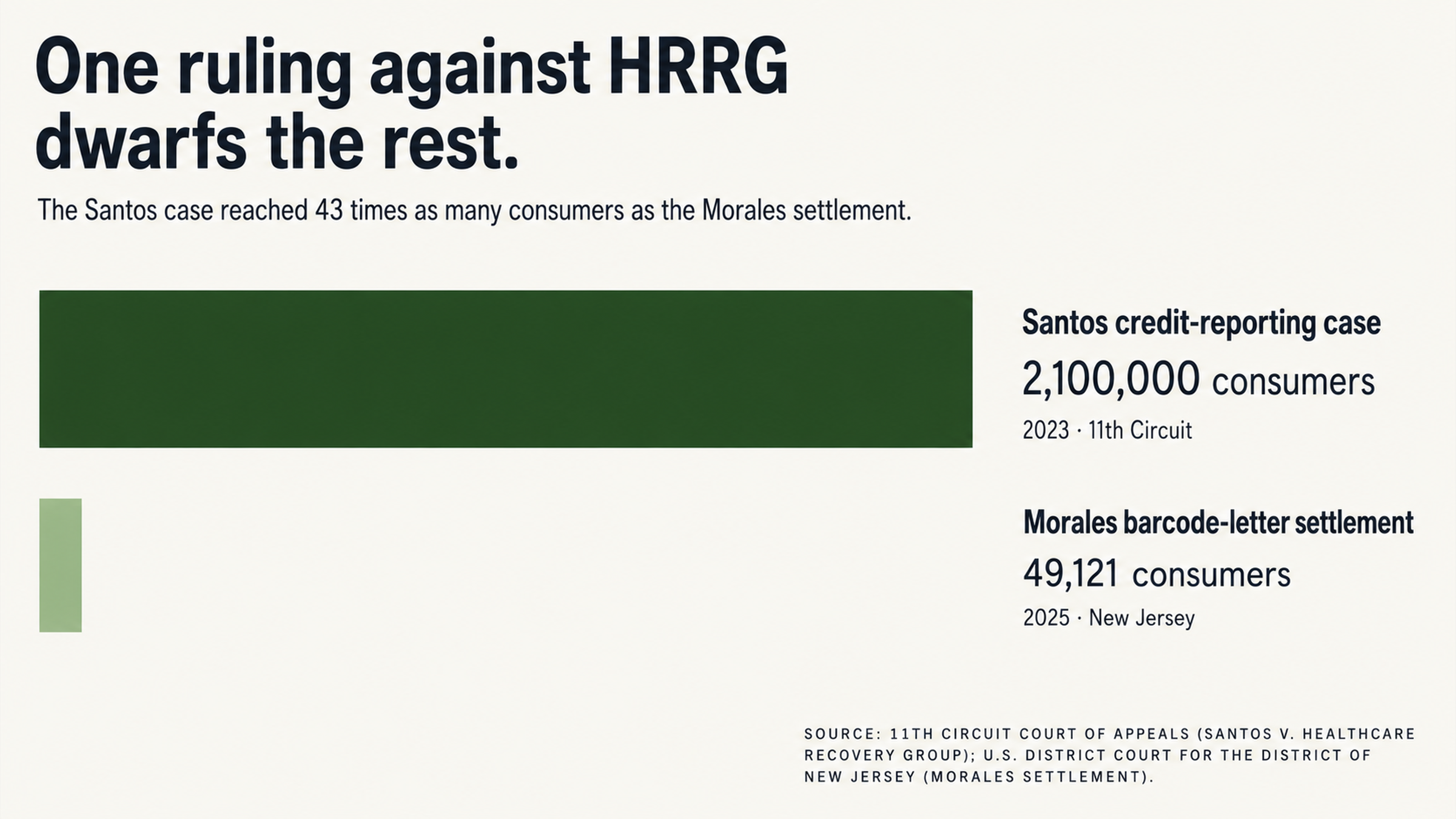
The Morales class-action settlement applied to 49,121 New Jersey residents. As part of the settlement, class members received payments.
A more concerning decision against HRRG came in November of 2023 when the 11th Circuit Court of Appeals found the company was reporting the wrong date to credit bureaus. The Santos class-action decision involved allegations that the company was reporting dates to the credit bureaus that made consumer accounts appear more recent than they actually were.
According to the appellate court's opinion, the decision applied to 2.1 million consumers over an 18-month period. Cases like Santos are more troubling because they indicate a systematic problem rather than an isolated issue.
Consumer Complaints Against HRRG
We know that HRRG engages in problematic collection practices based on their history of federal lawsuits. Beyond that, there are several documented patterns of consumer complaints that raise additional red flags.
The first pattern to consider is simply the sheer number of complaints filed against HRRG. On the ComplaintsBoard website, HRRG is rated 2.1 of 5 stars based on 68 reviews. Only 27% of complaints filed on the site have been resolved.
The Better Business Bureau reports between 252-339 complaints against HRRG depending on the timeframe that you search for. At one point in December of 2017, the company had an F rating with the bureau.
You may wonder why the volume of complaints matters when evaluating the legitimacy of collection activity. The answer is that these complaints often outline specific patterns that can be used to dispute a debt.
When you see the same type of complaints popping up across various platforms that involve allegations of harassment, wrong-person debts, and refusal to validate, you can make a strong argument that the account is not accurate.
The BBB indicates that it has tried to get basic business information from HRRG, but the company has failed to respond. If HRRG will not respond to something as simple as a BBB request, how will they respond to consumer disputes?
Regulatory Actions Against HRRG
In addition to consumer complaints, you should also consider regulatory actions taken against the company. In September of 2019, the Idaho Department of Finance filed a verified complaint for license revocation and issued a consent order against HRRG.
When a state issues a complaint seeking license revocation, it is one of the most severe actions the state can take. It demonstrates that there are concerns with the company's compliance and its ability to operate as a debt collector in the state.
Any state regulatory actions taken against HRRG should be considered if you are evaluating the validity of a debt the company is reporting. If a state has identified systemic problems with the company's collection practices, that information can be used to argue that the debt HRRG is trying to collect is not accurate.
Medical Debt and Credit Report Errors
If you have received a collection letter or noticed a collection account on your credit report from HRRG, it is essential to understand the potential problems with medical debt. Credit report errors are more common than you think.
A study conducted by U.S. PIRG found that as many as 79% of credit reports contain errors or discrepancies. Medical debt is one of the types of collection accounts most likely to contain errors.
The reason for the errors is the complicated nature of the billing process for medical accounts. If you go to the emergency room, you may receive bills from the hospital, the physician group that employs the emergency room doctors, the radiologist, the anesthesiologist, and a lab or two.
As a subsidiary of TeamHealth, it is likely that many accounts sent to HRRG for collection have been through multiple billing agencies before they reach the collection department. Each time an account is transferred from one entity to another, there is a potential for error.
The court's decision in the Santos case that HRRG was reporting the wrong dates on 2.1 million consumer accounts demonstrates how systematic these types of errors can become.
How to Check Your Credit Reports
Fortunately, you can get free copies of your credit reports from all three major bureaus to identify potential errors and vulnerabilities. AnnualCreditReport.com is a free website that you can use to request a copy of all three of your reports.
Once you have copies of your reports, review them carefully to identify any discrepancies. You may find that the same account is listed slightly differently on each report. Those types of discrepancies can be the basis for a legitimate dispute.
Insurance Billing Problems
Another potential error with medical debt involves the failure to properly bill your insurance before placing the account for collection. Many of the complaints filed against HRRG indicate that insurance was never billed on accounts.
One consumer indicated that an HRRG representative told her that her insurance company had denied the bill, but when she logged in to her insurance company's website, she saw that no claim had been filed.
Another consumer simply stated: "I paid the bill to the hospital DIRECTLY. The HOSPITAL told me this company is a fraud and they have patients complaining all the time about them." Stories like these demonstrate a breakdown in communication between health care providers, billing agencies, and collection departments.
In some cases, accounts are sent to collection before the provider has properly billed a patient's insurance. Other times, accounts may be sent to collection while the patient is in the process of working on a payment arrangement.
Regardless, if the account never should have been sent to collection in the first place, you may have a legitimate basis for disputing it.
Why You Should Not Pay HRRG Without Considering Your Options
If you are facing collection activity from HRRG, it is essential to consider the risks of simply paying the account. Paying a collection account is often one of the most instinctual responses, but it is a decision that should not be taken lightly.
When you pay a collection account, you are changing the status of the account from unpaid to paid. Beyond that, nothing else about the account is likely to change. The account will still remain on your credit report for seven years from the original delinquency date.
So, you will have resolved the issue of owing a debt, but the underlying credit damage will persist. When you make a payment on a collection account, you are also restarting the clock on the statute of limitations.
Further, when you make a payment, you are acknowledging that the debt is valid. If there were any potential issues with the validity of the debt, such as the amount or the fact that it is your debt, making a payment waives those potential defenses.
Finally, if you decide to make a partial payment or work out a payment arrangement, you will have to be in direct communication with the collector. This opens the door for additional follow-up calls and the potential that you could say something that will be used against you in the future.
Disputing a Collection Account from HRRG
The decision to dispute a collection account is an entirely different approach than simply paying it. When a debt collector is reporting a collection account, they have an obligation to ensure the account is valid and accurate.
If the collector cannot verify the debt or fails to respond to your dispute within the requisite timeframe, the law requires them to delete the account. There have been several federal court decisions involving HRRG that demonstrate problems with their documentation and validation procedures.
The Third Circuit found in Caprio v. Healthcare Revenue Recovery Group, LLC, that language in HRRG's collection letters may overshadow or contradict the required validation notice. The Levins case found that using the initials ARS rather than the company's full name may violate the requirement that collectors use their true name when communicating with consumers.
These decisions are important because they establish a pattern of behavior that could extend to individual cases. If HRRG is engaging in a pattern of behavior that courts have found problematic, it may be worth challenging their documentation and validation practices.
Why Professional Help Matters
Disputing a collection account is a complicated process that requires an understanding of federal law, state regulations, documentation requirements, and response deadlines. For most people, the information gap between consumers and debt collectors is a major problem.
HRRG is owned by one of the largest private equity firms in the world and has the resources of TeamHealth at its disposal. The company employs attorneys, compliance personnel, and customer service representatives that are well-versed in the federal and state laws that apply to debt collection.
If you attempt to dispute an account on your own, you will be going up against all of these resources. A debt collector will know what documentation to request, the deadlines that apply, and the magic language that will trigger legal protections.
A professional credit repair specialist works with collection accounts on a daily basis. They understand the pressure tactics, documentation errors, and procedural shortcuts that raise legitimate questions about the validity of a debt.
With extensive knowledge and experience, a credit repair specialist can help you develop a more effective dispute that will yield better results.
Will HRRG Sue You?
One of the most significant fears that consumers have when deciding whether to dispute a collection account is the risk of a lawsuit. Debt collectors like to use the threat of a potential lawsuit to motivate consumers to pay up.
In reality, the decision to file a lawsuit is a cost-benefit analysis. For most medical debts, the amount is simply not large enough to justify the cost of pursuing litigation, attorneys' fees, and court costs.
A review of HRRG's federal lawsuits demonstrates that the vast majority of cases involve consumers suing the company, not the other way around. While it is possible that HRRG may file a lawsuit in some instances, the threat of a lawsuit should not be the deciding factor in your decision to dispute an account or seek professional help.
Steps to Protect Yourself from HRRG
If you are facing collection activity from HRRG, there are several steps you can take to protect yourself. First and foremost, never initiate contact with the debt collector.
Several of the complaints filed against HRRG indicate that the company's representatives will ask for sensitive personal information before disclosing the purpose of their call. One consumer reported: "Every time this company calls me, the first thing they do is try to get my personal information. I have asked them numerous times what the call is in regards to. All they ever respond with is that it is a personal business matter, we need to first verify your identification."
Initiating contact with a debt collector is never a good idea. Anything you say in the conversation can be used against you at some point in the future. Further, when you call a debt collector, even if it is just to ask a question, you are engaging them.
It is always best to maintain your leverage and not engage a collector until you are in a position to resolve the account. If you must communicate with the debt collector, make sure you do so in writing.
Document Everything
Beyond refusing to initiate contact, it is also essential that you document all communication attempts made by HRRG. If the company calls you, note the date and time of the call as well as the phone number.
If they leave a voicemail message, save it. Take a photo or make a copy of any letters they send you and retain them for your records. In some cases, this documentation may become essential evidence if the company has violated a federal or state statute in its communication with you.
For example, if HRRG is calling you in a harassing manner, you may have a claim under a state or federal law. One consumer indicated that HRRG called every day at 8:06 AM. She described the calls as "disturbing" and "harassing."
If you are facing harassing calls from HRRG, make sure you document the date, time, and content of every call. The difference between an annoying debt collector and a harassing debt collector often comes down to documentation.
Check Your Credit Reports
Finally, make sure you are looking at your credit reports as part of any dispute or challenge to a debt. Your credit reports are one of the most critical pieces of documentation you can have in any dispute.
Through AnnualCreditReport.com, you can request a free copy of all three of your credit reports. Compare the reports line by line to identify any discrepancies. Are the accounts reported slightly differently on each report?
Are there any inaccuracies or errors in the reports? Any discrepancies or potential errors in the reports can become the basis for a legitimate dispute.
Conclusion
In conclusion, HRRG is a debt collection company that has affects millions of consumers every year. With their history of litigation, regulatory action, and consumer complaints, there is ample evidence of systemic problems that may raise questions about the validity of accounts they are reporting.
When a debt collector places a collection account on your credit report, they have an obligation to ensure it is accurate and valid. If it is not, you may be able to have it deleted.
Debt collectors rely on consumers feeling isolated and powerless when it comes to collection accounts. When consumers understand their rights, patterns of problematic behavior, and approach a dispute strategically rather than emotionally, the entire playing field changes.
If HRRG is on your credit report, you do not have to face them alone. The professionals at FightCollections.com specialize in challenging collection accounts and understand the specific patterns of problems associated with large collection agencies.
Our specialists understand what documentation to request, what timelines apply, and how to build an effective dispute based on the laws that collectors must follow. Every situation is unique, and your outcome will depend on the specific facts of your case.
However, the one thing that remains the same is that you cannot properly evaluate your options without extensive knowledge of the laws and procedures that apply. A consultation with a professional from FightCollections.com will help you better understand your specific situation and the options available to you moving forward.
Do not allow an HRRG collection account to dictate your credit future without exploring every option available to you. Contact FightCollections.com today to discuss your situation and learn how our professional dispute assistance can help you address collection accounts on your credit report.