

Does Penn Credit Corporation have you freaking out because you just saw them on your credit report? Are you worried you’ll have to explain yourself, or justify your past payments, or do whatever it takes to appease them and make this whole nightmare go away?
Here’s the truth these collection agencies don’t want you to know: The burden of proof is not on you. This is a federal law, and any debt collector who claims you owe them money has to be able to prove it, and provide you with all the necessary documentation.
Just like any other collection agency, Penn Credit has to prove not only that you owe the debt, but that you owe the correct amount, that you’re actually the person who owes it, and that they have the legal right to attempt to collect it. And if they can’t do all that, you can get this collection removed from your report entirely.
This isn’t about shirking responsibility and refusing to pay a debt you owe. This is about recognizing that as many as 79% of all credit reports contain some kind of error or inaccuracy, according to a study done by U.S. PIRGs. And when a debt collection agency like Penn Credit reports a collection account to the credit bureaus, there’s a good chance that something about that account is wrong, whether it’s the amount, the date, or something else.
So, who is Penn Credit Corporation, anyway? Keep reading to find out.
Penn Credit Corporation is a third-party debt collection agency with their headquarters located in Pennsylvania. Here is their contact information:
As a third-party debt collection agency, that means that Penn Credit Corporation doesn’t actually own most of the debts they’re trying to collect. Instead, they collect on behalf of the original creditor, for a fee or a percentage of the recovered debt.
This is how debt collection agencies make their money, and it can create some perverse incentives for them to pursue debts as aggressively as possible, even when they don’t actually have the correct information about that debt.
In the next section, we’ll go over some of the controversies and legal issues that have surrounded Penn Credit Corporation over the years.
Penn Credit Controversies & Lawsuits
There are a few different controversies and legal issues worth noting when it comes to Penn Credit Corporation.
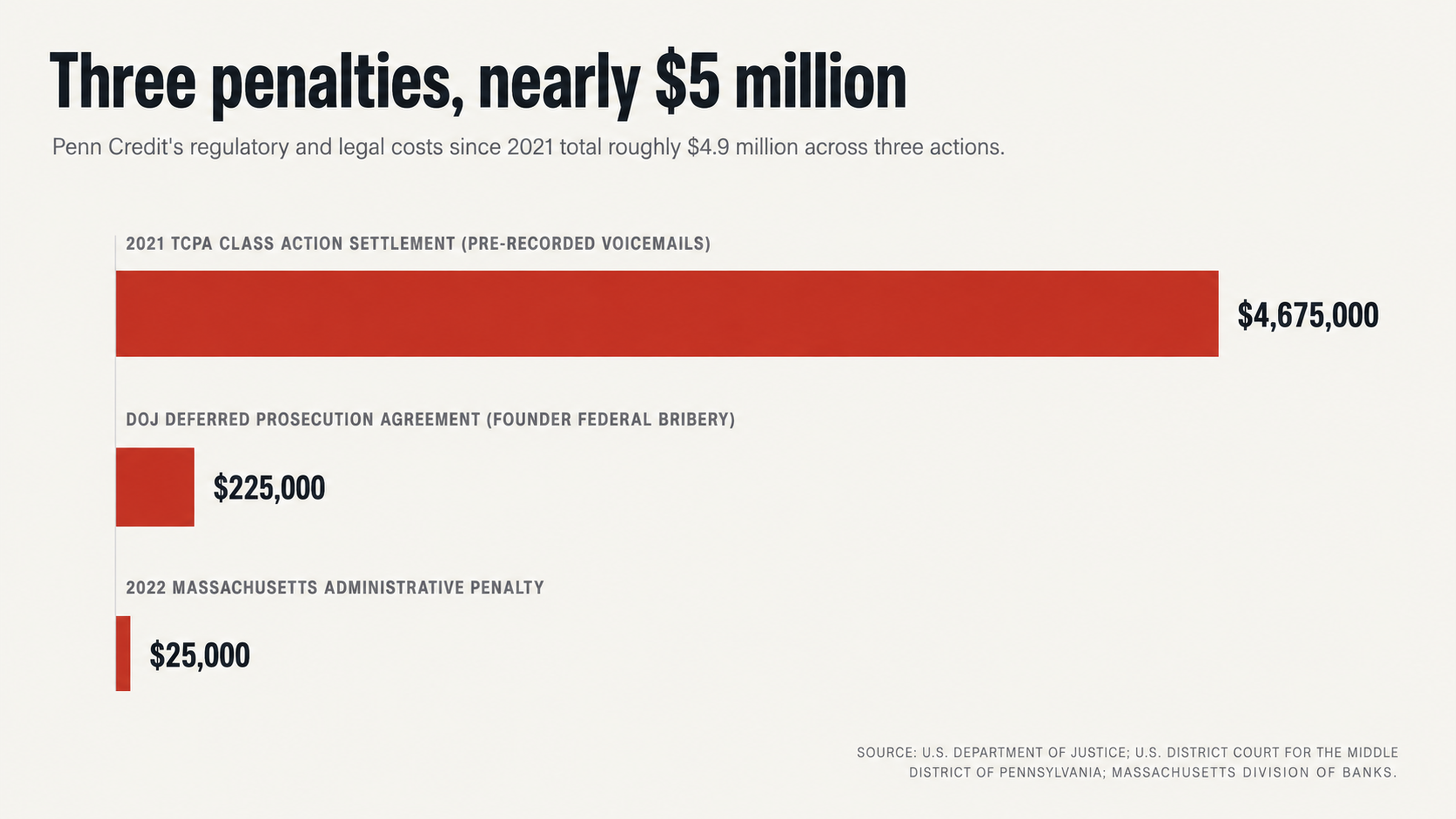
First, the company’s founder and former CEO, Donald Donagher Jr., recently pled guilty to federal bribery charges, and admitted that he had directed the company to provide money and services to court clerks in Illinois and Florida in exchange for receiving debt collection contracts. As a result, the company had to pay a $225,000 penalty as part of a Deferred Prosecution Agreement with the Department of Justice.
In addition, in 2021 Penn Credit agreed to a $4.675 million class action settlement, after they were accused of violating the Telephone Consumer Protection Act by using technology to deliver pre-recorded voicemails directly to consumers’ phones, without their consent. The proposed settlement included not only monetary relief but ten years of injunctive relief, which will require the company to implement a number of changes to their business practices, in order to ensure that they’re complying with the law and consumers’ rights.
And in 2022, the state regulators in Massachusetts issued a consent order which imposed a $25,000 administrative penalty on the company, and also required them to file regular compliance reports for a period of time.
These legal issues and controversies are not just anomalies – they represent a pattern of conduct, and they’ve already cost the company nearly $5 million in penalties and settlements since 2021. In the next section, we’ll talk more about what you can learn from Penn Credit Corporation’s reputation, and how you can use that information to your advantage.
What Does Penn Credit’s Reputation Mean For You?
You can learn a lot about how to handle a debt collection agency like Penn Credit Corporation by taking a closer look at their reputation.
Consumer Complaints
For example, if you check out Penn Credit Corporation’s rating with the Better Business Bureau (BBB), you’ll see that they have an A+ rating, which might seem like a good sign at first – until you realize that they also have more than 628 complaints filed with the Consumer Financial Protection Bureau (CFPB) in just the past three years alone. More than 400 of those complaints were filed in the last year. And if you scroll down to the customer reviews on their BBB page, you’ll see that they have an average of just 1.5 out of 5 stars. On Google, the company has an average of just 1.3 out of 5 stars.
Here’s what one verified BBB reviewer had to say: “If I could give 0 stars I would. This credit collection agency should NOT have an A+ rating from the BBB. The woman on the phone violated the Fair Credit Reporting Act and then when she didn’t like that I called them out on it hung up on me.”
The most common complaints about the company seem to involve attempting to collect debts that consumers say they’ve already paid, attempting to collect the wrong amount, failing to provide proper verification of the debt, and placing an excessive number of phone calls. Some consumers even report that the company is calling them as many as 20 or 30 times per day.
Clearly, there seems to be some kind of systemic problem here, rather than just the occasional one-off mistake.
The Documentation Problem
When you’re dealing with a debt collection agency like Penn Credit Corporation that’s operating on this kind of scale, it’s not hard to see how the documentation could get fouled up. After all, this company is collecting debts for hundreds of different original creditors, across multiple different states and industries. And every single time that a debt gets passed from one company or collector to another, there’s the potential for the documentation to get lost, or corrupted, or entered incorrectly into someone’s computer system.
That’s why it’s so important to remember that the burden of proof is on them, not on you. Penn Credit Corporation may be claiming that you owe a certain debt, but can they actually prove it? Do they have the original contract that you signed? Do they have records of every single payment you made, and every single fee that was assessed to your account?
In a lot of cases, the answer will be no – and if that’s true, you may be able to get this collection removed from your credit report entirely. In the next section, we’ll go over some of the reasons why you may not want to rush to pay off your debt right away.
Why You Shouldn’t Pay a Collection Without a Second Thought
For a lot of people, the first reaction when they see a collection account on their credit report will be to pay it off as soon as possible. But this isn’t always the right move, and rushing to pay a collection without giving it any thought could actually end up hurting you in the long run.
The Payment Paradox
For example, when you pay a collection account, you might assume that it will be completely removed from your credit report – but unfortunately, that’s just not true. Instead, the account will simply be marked as “paid,” which means that the damage has already been done. The collection will still be on your report, and it will still be affecting your credit score – and this can continue for years after you’ve paid the collection in full.
Settlement offers can be a little trickier, because depending on the way that the creditor reports the debt, and a few other factors, it’s possible that accepting a settlement could actually help or hurt your credit score. The problem is that there’s just no way to predict how it will go, so it’s better to try disputing the debt first. If you’re able to get the collection removed from your report entirely, that will always be better for your credit score than simply paying it.
The Information Imbalance
Finally, it’s worth noting that collection agencies like Penn Credit Corporation have a big advantage when it comes to this kind of situation – and it’s not because the law is on their side. Instead, it’s just because they do this for a living, and you probably don’t. That means that they have a lot more information about how the system works, and what their rights are under the law – and they know exactly which tactics are most likely to get you to pay up without asking any questions.
They know that most consumers aren’t aware that they have the right to request verification of a debt before they pay anything, so they’re not afraid to use high pressure sales tactics to try and get you to pay without verifying the debt first. This can include sending you letters with urgent deadlines, or placing dozens of phone calls to you every day. Their goal is to make you feel like you need to respond right now, rather than taking the time to think carefully about your options and decide what’s really in your best interests.
But once you understand what’s really going on here, you can start to take control of the situation, and come up with a plan to protect yourself and your finances.
Understanding the Role of Ignoring Their Calls
Penn Credit will call you, and call you, and call you, but do you know why? It’s because the Fair Debt Collection Practices Act (FDCPA) allows you to request that they stop contacting you. You have the right to ask them to cease their communications, and you aren’t obligated to answer their calls or respond to their letters.
The FDCPA is a law designed to protect consumers from the unfair and abusive practices of third-party debt collectors like Penn Credit. The law regulates what debt collectors can and cannot do when collecting a debt, and it provides consumers with recourse when a debt collector violates the law.
What the FDCPA says is that you have the right to stop calls and letters from debt collectors. When Penn Credit calls you, it’s because they’re hoping you’ll answer the phone and say something they can use against you. They want to pressure you into agreeing to a payment plan or admitting that you owe the debt. They want every opportunity they can get to gather more information from you and build their case against you. If you ignore their calls, you’re not giving them anything to work with.
Of course, this doesn’t mean that you should completely ignore the situation. Instead, you should communicate with them in a way that works in your favor. For example, you can put everything in writing so that you have a paper trail, and you can have a professional represent you so that you don’t accidentally say something that hurts your case. But you don’t have to answer your phone every time Penn Credit calls you.
What the Law Requires
Penn Credit and other debt collectors must follow the law when collecting debts. Within 5 days of their initial contact with you, they’re required to send you a written notice with the amount of the debt, the name of the creditor, and a statement that says you have the right to dispute the debt. If you send them a written dispute within 30 days, they have to stop trying to collect the debt until they send you verification.
The verification requirement is a big deal. Penn Credit can’t just claim that you owe them money and expect you to pay up. They have to show you proof that you owe the debt, and if they can’t, then the debt is invalid.
The FDCPA also prohibits debt collectors from harassing, threatening, or using deceptive practices to collect debts. Given that Penn Credit has been sued by the CFPB and has had thousands of complaints filed against it with the CFPB and the BBB, it’s especially important to know your rights when it comes to harassment and deception.
How to Strategically Handle a Collection From Penn Credit Corporation
When Penn Credit contacts you about a collection, the best course of action isn’t to call them and try to negotiate a settlement or to immediately send them a check to pay the debt. Instead, it’s to dispute the collection and make Penn Credit verify that it’s valid.
You see, it’s possible to get collections removed from your credit report if they’re inaccurate, if they’re invalid, or if they can’t be verified within a reasonable amount of time. Since Penn Credit collects debts for many different original creditors and deals with such a high volume of accounts, there’s a good chance that they’ll make a mistake. They might mix up account numbers or miscalculate balances. They might attempt to collect debts that were already paid to the original creditor. In some cases, they might even be collecting debts from the wrong people altogether.
If you dispute a debt in writing, Penn Credit will be required to verify it by providing documentation to prove that it’s real. If they can’t meet the deadline for verifying the debt or if they can’t provide adequate documentation, the credit reporting agency has to delete it from your report.
Of course, you can dispute a debt on your own, but it’s a good idea to consider hiring a professional for help. A credit repair expert knows how to identify the types of errors and inaccuracies that you might overlook, and they can communicate with the credit reporting agencies and debt collectors on your behalf so that you don’t have to talk to them directly. Debt collectors often employ tactics designed to get you to pay without questioning the debt, and it’s easy to inadvertently make the situation worse and end up owing money that you don’t actually owe.
Professional credit repair specialists understand the FDCPA and how it applies to your situation. They understand your rights as a consumer dealing with debt collectors and credit reporting agencies. Don’t try to navigate the system on your own and risk unintentionally digging yourself into a deeper hole. Let a credit repair expert guide you through the process and advocate for you when you need it most.
Why Acting Quickly is Important
It’s true that you shouldn’t rush into a decision when a debt collector calls you and demands payment. But it is a good idea to act relatively quickly when dealing with a collection account on your credit report.
The reason for this is that the longer a collection account remains on your report, the more damage it will do to your credit score. You want to address the situation before things escalate and the problem becomes even harder to solve. For example, if you wait too long to dispute a debt that’s invalid, the collector may send it to multiple credit reporting agencies, and then you’ll have to dispute it with each of the agencies individually. Or the debt may be sold to another collector, which can make things even more complicated.
In addition, prompt action can help you avoid a situation in which you feel like you’re backed into a corner. Don’t give a debt collector the opportunity to push you into a payment plan or a settlement agreement that isn’t actually in your best interests.
How Debt Buying Works
Debt buying is a common practice within the debt collection industry. When the original creditor decides that it’s unlikely to collect a debt, it may sell the debt to a debt buyer for pennies on the dollar. The debt buyer then attempts to collect the full amount of the debt and pockets the difference as profit.
Penn Credit Corporation primarily acts as a third-party debt collector rather than a debt buyer, but debt buyers face a big problem when it comes to documentation. When debts change hands, the paperwork doesn’t always follow, so debt buyers may not have access to all of the documentation for the debt, including the original contract and payment records.
Regardless, the burden of proof is still on Penn Credit Corporation. When the company claims that you owe a debt, it’s up to them to prove it. And if they can’t, you could be in a position to have the collection removed from your credit report altogether.
Don’t Let Them Win
Penn Credit Corporation makes its money from collecting debts, but the company has a history of engaging in bad behavior to get what it wants. From federal bribery charges to a multimillion-dollar settlement with the CFPB to thousands of complaints registered with the CFPB and the BBB, there are plenty of reasons to question whether the debts that Penn Credit Corporation is collecting are valid.
The burden of proof is on them, not on you. Penn Credit Corporation has to verify that the debt is real and that it’s reporting your credit information accurately. And if they can’t do that, the collection account could be removed from your credit report entirely.
You don’t have to go through this process alone, and you shouldn’t simply take the word of Penn Credit Corporation that the information they’re reporting about you is accurate. The debt could be invalid. The information could be a mistake. The tactics that they’re using to collect the debt are designed to intimidate you into paying without asking any questions, but asking questions is exactly what you should do.
Contact us at FightCollections.com today for a free consultation.