

If you see a Williams and Fudge collection account on your credit report, you likely already know that finding new collections on your report is one of the most unpleasant experiences you can have.
First, you see that someone else is claiming you owe them money, then you find yourself scrambling to understand who they are and why you owe the debt. Finally, you are forced to wonder how this will affect your credit score. You are not alone and you do have options available to you.
When most people see a collection account from Williams and Fudge, their first thought is to pay them. This is an understandable reaction but in many cases, it may not be the best move. Before you contact them or send in any payment, you need to know who they are and what your options are to get this collection off of your credit report.
Williams and Fudge is a debt collection agency that primarily collects debts related to education. They collect debt from outstanding student loans, tuition, and even fees for campus services on behalf of universities and colleges across the nation. Here are the details you need to know about this agency:
Williams and Fudge has been in business for almost 40 years and has 370 employees. Because they specialize in educational debt, most of their targets are former students.
Williams and Fudge on the Better Business Bureau
Williams and Fudge has an A+ rating from the Better Business Bureau but in the last three years, they have had 207 complaints filed against them. In the last year alone, 55 complaints were closed. The reason their rating is so high despite their many complaints is that the BBB does not factor in their customer review score. When you look at that score, you find that they have a 1.27 out of 5-star rating.
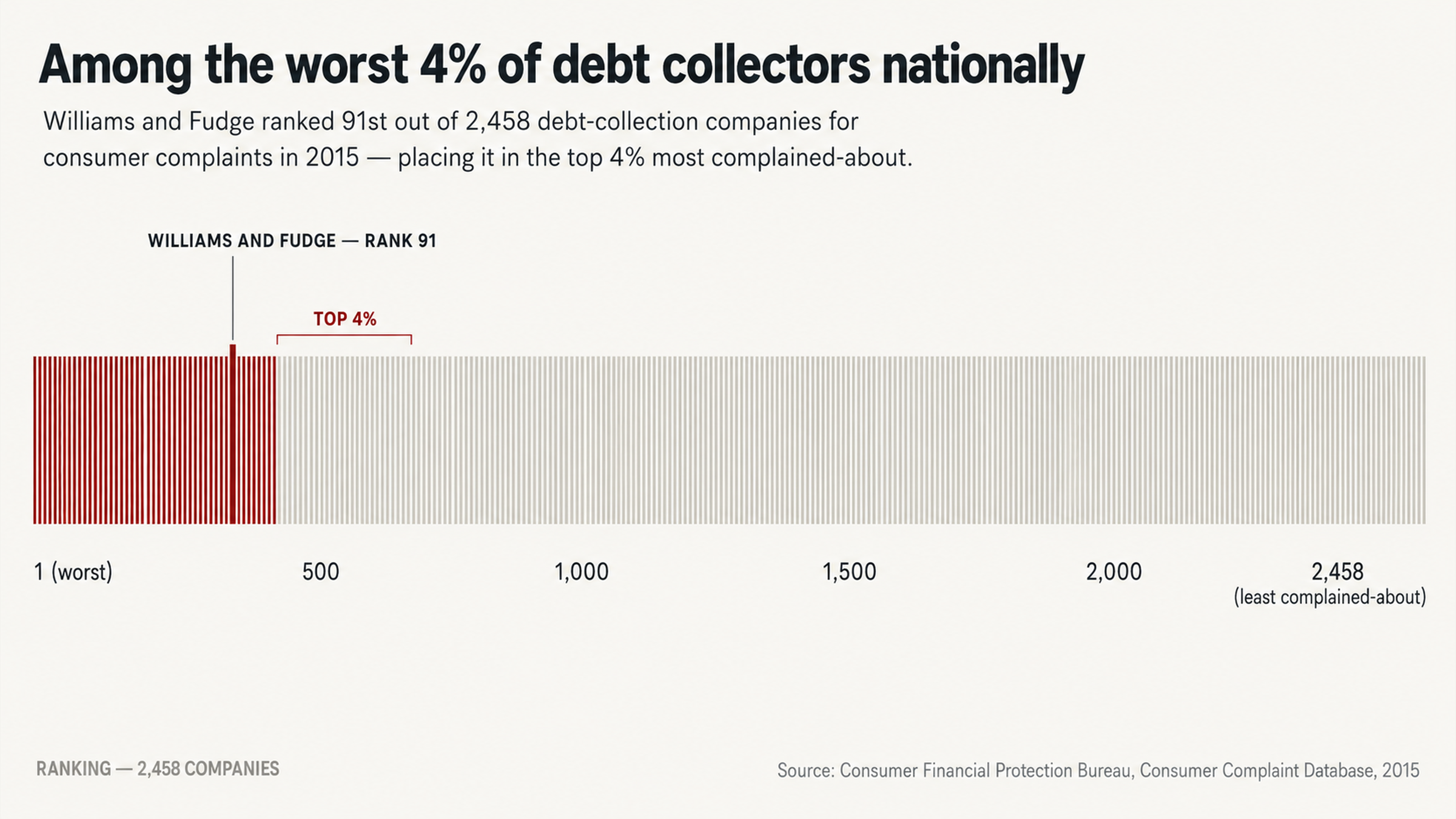
In 2015, Williams and Fudge was ranked the 91st most complained about debt collection company in the nation by the Consumer Financial Protection Bureau. They ranked in the top four percent out of 2,458 companies for the number of complaints they received. These complaints represent people who were so upset with the company that they took the time to file a formal complaint.
One customer complaint filed with the BBB says, "I have received multiple calls a day, even when I am at work. I got fired and even when I told them I don't have any money they got aggressive. They made me cry on the phone. I have an anxiety disorder, I can't focus when people yell at me." Hundreds of complaints tell the same story.
What Are Your Rights When Dealing with a Collection Agency?
When a debt collector contacts you, it's easy to feel like you have no power in the situation. This feeling is exactly what they are hoping for. When you don't know your rights, you are at a disadvantage. Once you understand the laws that govern debt collection agencies, you begin to regain your power.
Your Rights Under the Fair Debt Collection Practices Act
The Fair Debt Collection Practices Act (FDCPA) says that a debt collector must:
Identify themselves as a debt collector
Only contact you at reasonable hours
Not discuss your debt with third parties
Provide debt validation if you request it
These are not suggestions. They are laws that debt collectors must follow.
Your Rights Under the Fair Credit Reporting Act
The Fair Credit Reporting Act (FCRA) requires that any information reported to the three major credit bureaus must be both accurate and verifiable. If the information cannot be verified, it must be removed from your credit report. Again, this is not a suggestion. This is the law.
According to studies done by U.S. PIRG, 79% of all credit reports contain either errors or serious errors. This means that most information on your credit report is likely to be incorrect or unreliable. The collection account from Williams and Fudge on your credit report may be among the unreliable information.
Has Williams and Fudge Violated Your Rights?
Williams and Fudge has been sued in federal court and found to have violated the FDCPA "as a matter of law." This means that a federal judge determined that the company broke the law. The violations in this case included:
Disclosing details of the debt to the wrong person
Failing to disclose that they were a debt collector
Contacting third parties to discuss a consumer's debt
Many consumers have filed complaints that the company is still violating their rights. One complaint says that a representative from Williams and Fudge disclosed details about her debt to a family member. Another says that the company called her at work even after she asked them to stop.
The company has also been the subject of several class action lawsuits. One alleged that the language they used in collection letters was deceptive to consumers. Another alleged that the company was making unlawful telemarketing calls. In 2019, a class action suit alleged that the company's collection letters inaccurately indicated that an attorney was involved in the collections process.
Should You Pay Williams and Fudge?
When you are in a difficult financial situation and a collector is calling you, demanding payment, it can be tempting to just pay what they say you owe. This is the reaction that the collector is hoping for. Before you make a payment, understand how it will affect your credit report.
Paying the Debt May Not Remove It from Your Report
If you pay a collection account, your credit report will be updated to show that the account is "paid." Unfortunately, this does not mean that the account will be removed from your report. The paid collection will still be listed on your report and will still be used to calculate your credit score.
This does not mean that you should never pay a collection account. Sometimes paying is the right thing to do. However, it should always be a strategic decision and not one you make in the heat of the moment because a collector is being pushy.
Many of the complaints about Williams and Fudge include consumers who say that the collector was pushy and demanding. One complaint filed with the BBB says, "This representative was yelling at me to the point where people 5 feet away could hear him yelling at me through the phone and was demanding I give him a credit card to pay $4800 right now." This is the kind of treatment you can expect from a pushy debt collector.
Getting the Account Removed Is a Better Option
Instead of paying Williams and Fudge, you should consider trying to get the account removed from your report entirely. This is the best way to improve your credit score and is a permanent solution. When you pay a collection account, the account remains on your report for seven years from the original delinquency date.
To get an account removed, you can dispute it with the three major credit reporting bureaus. If the credit bureaus cannot verify the information in your report, they must remove it.
Williams and Fudge likely cannot verify the information in your report. Many collection agencies do not have the documentation necessary to verify the debts they are collecting, especially if they have purchased the debt from another agency.
Contact a credit repair expert like Credit Repair Experts to help facilitate the removal of the Williams and Fudge collection account from your report. They have experience with aggressive collection agencies like Williams and Fudge and understand how the credit reporting system works. Let them help you improve your credit report today.
The Dispute-First Approach
When you dispute a collection account before deciding whether you owe it, you fundamentally change the typical collection equation. The burden shifts from you to them. Now, they have to jump through hoops instead of the other way around. This isn't a technicality or a loophole. It's how the system is supposed to function.
Why Disputes Work
Williams and Fudge collect debts for hundreds of clients. In a single year, they handle over a billion dollars in placement volume. They buy debt packages, often without full records. The older a debt, the more likely that paperwork is missing, corrupted, or was never transferred correctly. When you dispute a debt, you are asking the collection agency to verify information that may not exist in a usable form.
Williams and Fudge's own history includes a federal court decision that found the company in violation of the FDCPA, hundreds of consumer complaints filed with the Consumer Financial Protection Bureau, and at least two class-action lawsuits. Consumer complaints against the company include attempts to collect debts that were already paid or debts that belong to someone else entirely. At least one complaint details a debt that somehow increased by nearly $1,000 from the original amount, with no explanation.
These aren't minor issues. These are precisely the kinds of problems that a dispute is meant to identify.
The Power of Verification Requests
Federal law allows you to request verification of a debt that any collection agency claims you owe. This isn't a request for the collection agency to simply repeat what they've already told you. It's a requirement that they must provide actual documentation that proves the debt is yours, the amount is correct, and the debt is legally collectible.
In this process, your silence is golden. You're under no obligation to say anything that helps a collection agency do its job. You're under no obligation to even answer their phone calls. If you communicate only in writing, you build a paper trail and you take the time pressure out of the situation. Collection agencies use phone calls because they can apply tremendous pressure in real-time. They can't do that if you insist on written communication only.
Many consumers in your situation make the mistake of thinking that if they talk to a collection agency, explain their situation, or make a partial payment, things will get better. In reality, such actions can renew a statute of limitations, acknowledge a debt you may not owe, and give a collection agency exactly what it needs to continue harassing you. The less you say, the better off you are.
How Professional Credit Repair Can Help
The dispute process has very specific rules, timelines, and steps you must take. It's good that you know your rights in this situation. But successfully navigating the system requires knowledge of how credit reporting agencies and collection agencies respond in real life. That's where a professional credit repair agency can help.
The Advantage of Expert Intervention
Professional credit repair experts work with companies like Williams and Fudge all the time. They know exactly what kinds of documentation issues typically arise with educational debts. They know which arguments work with credit reporting agencies and which tactics tend to succeed. They have expertise you cannot match as an individual who has never disputed a debt before.
Working with a professional credit repair agency also means you don't have to deal directly with a collection agency. You don't have to endure dozens of phone calls. You don't have to navigate a conversation designed to trip you up and get you to admit something you don't owe. Your representative will handle all communication with a collection agency while your dispute is underway.
According to complaints filed against Williams and Fudge with the Consumer Financial Protection Bureau, calling patterns include: up to 20 calls within a two-minute span, calling from more than 50 different spoofed numbers, and calling consumers at work and at the homes of their family members. When you have professional representation, you don't have to endure any of this.
A Free Consultation Changes Everything
For many consumers, the embarrassment or shame they feel about dealing with a collection agency prevents them from seeking help. They don't want to explain their situation to anyone. They don't want to be judged. They don't want to find out that their situation is as bad as they think it might be.
A free consultation eliminates all of those concerns because it doesn't obligate you to anything. During your free consultation, you'll find out what your options really are. You'll learn what a successful outcome could look like. You'll get information that will help you make informed decisions instead of reactive ones. You'll get all of this for free and without any commitment whatsoever.
In addition to the technical help a professional credit repair agency can provide, you'll also get enormous emotional relief. You won't be facing a giant corporation all by yourself. You'll have someone on your side with expertise and experience. That makes all the difference in the world.
A Williams and Fudge listing on your credit report is not a permanent reflection of your worth as a human being or your creditworthiness. It may be an error. It may be something you don't actually owe. It may be a listing that violates federal law. Williams and Fudge's own record, which includes a federal court ruling against it for violating the FDCPA, hundreds of complaints from other consumers, and multiple class-action lawsuits, suggests that you should approach any information the company provides with a healthy dose of skepticism.
The feelings you have when you're dealing with a debt collector — the panic, the embarrassment, the feeling that you have to do something right now — are all completely understandable. But recognize that those feelings are also exactly what debt collectors want you to feel. They want you to feel that way because it means you'll make decisions that help them, not you.
What you owe and what anyone can collect from you are two very different things. What's currently on your credit report and what should be on your credit report are also two different things. That's why the dispute process exists in the first place. Disputes exist because errors are so common and because so many debts can't be verified. You have more options than a debt collector wants you to think you do.
Take the First Step Today
FightCollections.com is currently offering free consultations to consumers who are dealing with collection agencies like Williams and Fudge. There's no obligation. There's no judgment. There's no pressure. You'll simply find out what your options are and what kind of outcomes you can reasonably expect from your current situation.
You've already taken one of the most important steps, which is reading this information instead of reacting emotionally to your situation. Now, it's time to take the next step, which is getting expert eyes on your situation.
Contact us at FightCollections.com today to arrange for your free consultation. Then, discover what's possible when you have expert advocates working for you instead of against you. The journey ahead of you begins with a single decision, which is to get some help instead of going it alone. Make that decision today.