

Marcus knew that before applying for a mortgage, he had to pull his credit report to make sure everything looked clean. Unfortunately, he found a surprise: there was a collection agency by the name of Express Recovery Services that was showing up on all three credit bureau reports for a collection amount of $2847.
Marcus had no recollection of having any debt with this company, and he couldn’t believe they had contacted the credit bureau without sending any previous letters to his address.
Thousands of consumers encounter Express Recovery Services on their credit reports each year, often without any prior warning or communication.
In many cases, these debts can be removed and the negative mark deleted from your report for good. Here’s how you can beat them at their own game.
Who is Express Recovery Services?
Express Recovery Services, Inc. is a debt collection agency based in Utah that was founded in 1996. Here is some basic information about the company:
Express Recovery Services primarily focuses on collecting medical and healthcare debts. They also collect utility bills on behalf of companies like Rocky Mountain Power and Dominion Energy.
The company employs between 70-95 collection consultants and reports over $100 million in annual receivables.
Federal Settlement for Systemic Violations
In October of 2020, Express Recovery Services agreed to pay a $15 million civil penalty to the Consumer Financial Protection Bureau after the federal agency concluded that the company had engaged in a systemic pattern of violating debt collection laws.
The CFPB specifically stated that the company had filed lawsuits against consumers without having the requisite documentation to prove that a legitimate debt was owed. They collected debts without providing legally mandated disclosures. They failed to verify disputed debts within the 30 day window required by federal law.
The federal government concluded that the company had collected debts where the statute of limitations had run out. They used false, deceptive, and misleading representations when attempting to collect debts. The violations were not one-off situations but instead a pattern of systemic violations that affected thousands of consumers.
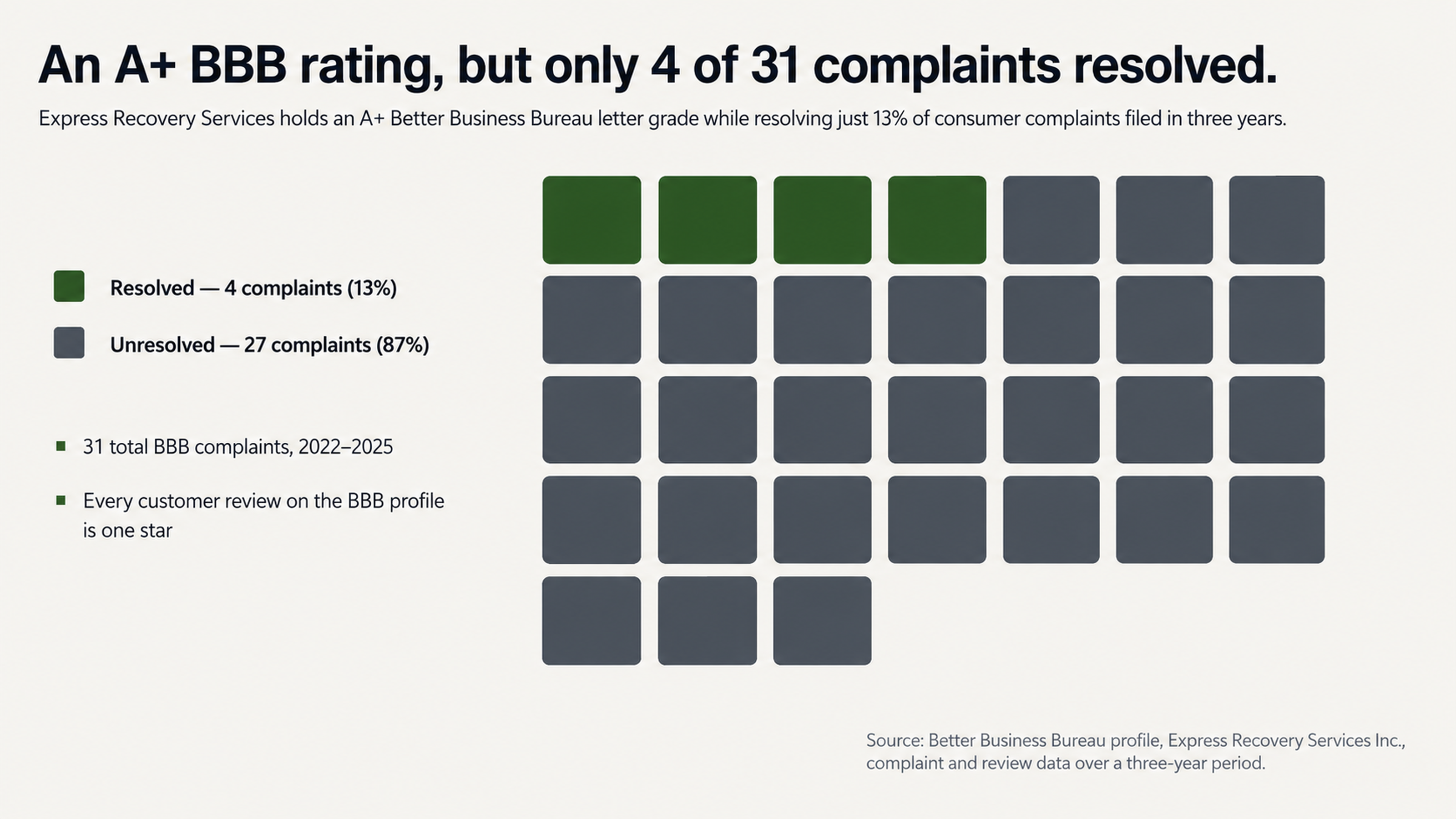
Despite boasting an A+ rating with the Better Business Bureau, the company has had 31 complaints filed against them in the last three years. Only four out of 31 complaints were resolved to the satisfaction of the consumer, which is a resolution rate of just 13%. Every single customer review on their profile is a one-star review.
Don’t Pay This Collection Until You Read This
The Payment Paradox
When Marcus saw the negative mark on his credit report, his first instinct was to pay off the collection agency so that the account would be deleted.
This is exactly what the company wants you to do. In fact, this is the business model for collection agencies: to scare you into paying a debt as quickly as possible. This is why they are so aggressive on the phone and through the mail.
Here’s the thing: paying a collection account does not mean it will be removed from your credit report. In fact, once you pay it, the status will simply be updated to a paid collection, and it will remain on your report for seven years from the date it originally went delinquent. You’ve paid the debt, but nothing has changed in terms of cleaning up your credit report.
Studies by U.S. PIRG have shown that 79% of credit reports contain errors or serious mistakes. If you combine this with the fact that Express Recovery Services has a history of attempting to collect debts from the wrong consumers, you will see why paying them right away may not be the best strategy.
What Express Recovery Services Wants
Companies like Express Recovery Services are not scam operations. They are legitimate businesses attempting to collect debts owed.
However, they do engage in very aggressive (sometimes harsh) tactics because the longer it takes them to collect a debt, the less money they will make. Every day a debt goes uncollected means another day of lost revenue for the company, which is why they will push so hard to get you to pay right away.
The company has a huge information advantage. They have records related to your account. They have histories of their collection attempts. They have legal resources available to them. When they contact you, they know more about your situation than you know about theirs. This information disparity inherently tips the scales in favor of the collection agency.
Several consumer reviews have mentioned that Express Recovery Services attempted to collect a debt from the wrong consumer. Here’s what one consumer had to say:
This is not a unique situation. We’ve seen the same types of complaints on multiple review websites.
The Strategic Power of Silence
Why You Shouldn’t Answer Those Phone Calls
When Express Recovery Services calls you, it’s tempting to pick up the phone to tell them that they have the wrong person.
Marcus received multiple calls per day, and his first instinct was to call them back to tell them that they made a mistake. Thankfully, he didn’t.
Anytime you speak with a debt collector, you’re providing them with information that they can use against you. Even if you say something seemingly innocent, they can use your words against you, and there’s always a chance that they may have recorded the conversation.
Instead, let the phone calls go to voicemail and work with a reputable credit repair company that understands the nuances of federal and state credit laws.
Remaining silent gives you control of the timeline and medium of communication. Collection agencies rely on getting verbal commitments from consumers and playing on their emotions to get a quick resolution.
By refusing to engage them directly, you’re denying them the quick fix that their business model relies on while preserving your rights under federal law.
Time is on Your Side
The CFPB found that Express Recovery Services was suing consumers for debts where the statute of limitations had already run out. This is against the law, but it goes to show just how hard collectors will push to collect a debt regardless of whether they can legally enforce it.
The older a debt gets, the less of a threat it becomes. Collectors know this, which is why they’re so urgent to get a consumer to make a payment or acknowledge the debt early in the process.
The longer you can go without making a payment or verbal commitment, the less leverage the collector has.
In our experience, Express Recovery Services rarely sues individual consumers. Going to court is expensive and time-consuming. They were just penalized $15 million by the feds because they sued consumers without the proper documentation. If they’re threatening to take you to court, it’s likely an idle threat.
Federal Laws Give You Leverage
The FDCPA and FCRA Are Not Just Defensive Tools
Most consumers think of the Fair Debt Collection Practices Act (FDCPA) and the Fair Credit Reporting Act (FCRA) as laws that defend their rights as a consumer. While that is true, these laws also provide offensive tools that can be used to challenge and ultimately remove a debt.
Both laws require the collector to meet minimum standards that many fail to achieve.
Under the FDCPA, Express Recovery Services is required to send verification of the debt within 30 days after receiving a written request from the consumer. As we mentioned earlier, the CFPB found that the company failed to meet this requirement on multiple occasions.
If the collector cannot verify a debt, the credit bureau must remove the account from your report.
Some class-action lawsuits have uncovered other weaknesses. A Georgia lawsuit alleged that Express Recovery Services sent collection letters that failed to properly identify the name of the creditor. The letters also illegally threatened to charge consumers interest when in reality, no such interest applied.
These are the types of violations that credit repair specialists understand how to leverage to your advantage during the dispute process.
The Importance of Professional Help
Why DIY Repair May Leave You Exposed
When Marcus pulled his report and saw the collection account, his first instinct was to try and handle the dispute himself. He drafted a validation letter and was prepared to mail it to Express Recovery Services.
The problem was that he was unaware of how easy it is for a consumer to make a tactical mistake that could strengthen the position of the collector instead of weakening it.
Credit repair experts understand the exact language, timing, and procedure to use in order to maximize the chances of having the account successfully deleted. They understand which credit bureau procedures to invoke and how to document violations in a way that creates legal exposure for the collector.
This knowledge cannot be replicated by reading a few articles on the internet.
Express Recovery Services claims that they provide extensive training to their collection staff to ensure compliance with federal and state law. Despite this, their pattern of consumer complaints (even after the $15 million settlement) suggests that the individual consumer is at a significant disadvantage.
In November of 2025, a consumer filed a complaint alleging that Express Recovery Services called them after they filed for bankruptcy. This is a clear violation of the FDCPA.
Having professional representation in your corner evens the playing field.
The Dispute-First Strategy
Why You Should Challenge Before Paying
The core philosophy that ultimately led to Marcus getting a successful deletion was simple: dispute first and pay later.
This strategy recognizes that in many cases, a collection account can be deleted if the information is inaccurate, fraudulent, erroneous, or simply cannot be verified in a timely manner.
Express Recovery Services deals with debts that may have been sold multiple times before landing on their desk. Sometimes medical bills are sold to a collection agency without the agency receiving all the documentation.
Utility bills may change hands as consumers switch accounts, and vital information may be lost in the transfer. The original creditor may not have all the information or may have outdated information by the time Express Recovery Services receives it.
Every gap in documentation, every procedural mistake, and every failure to verify in a timely manner is a potential opportunity to have the account deleted.
We’ve already mentioned that several consumers have reviewed Express Recovery Services, alleging that the company attempted to collect a debt that they claim they do not owe or have already paid.
Here’s what one reviewer had to say:
"We solved this problem several months ago talking with one of their personnel. At that time we were told the charge was an error and they would make sure it would be closed. Here it is again with the same threat."
What a Successful Dispute Looks Like
Marcus worked with a credit repair company that initiated a dispute with all three credit bureaus. The dispute claimed that Marcus was questioning the accuracy and verification of the Express Recovery Services account.
During the investigation period, the credit bureaus reached out to Express Recovery Services to verify the account.
When Express Recovery Services was unable to verify the account within the allotted period, the account was deleted from all three credit reports.
Marcus never paid a single dollar on a debt that he did not feel he owed. The negative mark was removed from his report, and he was ultimately able to qualify for his mortgage at a competitive rate.
We cannot guarantee this exact outcome for every consumer. However, it does illustrate why the dispute-first strategy makes so much sense.
If Marcus had simply paid the collection agency out of fear, he would have wasted nearly $3000 on a debt he did not owe, and the negative mark would have remained on his credit report regardless.
Conclusion
Express Recovery Services is one of the larger regional debt collection companies in the western United States. Their $15 million federal penalty, their documented history of attempting to collect from the wrong consumer, and their dismal 13% resolution rate for consumer complaints paint a picture of a debt collection company that is willing to do whatever it takes to collect a debt.
If you have Express Recovery Services on your credit report, you need to understand that you have options available to you other than simply paying what they say you owe.
Between the high frequency of errors on credit reports and the documented history of Express Recovery Services failing to comply with federal law, it’s fairly common to get the account deleted after initiating a dispute.
Don’t let fear force you to pay them thousands of dollars on a debt you may not owe. Don’t play their game on their home turf. Don’t provide them with information that they can use against you.
The law is on your side, but only if you understand how to use it to your advantage.
Take Action Today
If Express Recovery Services has placed a collection account on your credit report, it’s essential that you take action today. Please contact us at FightCollections.com for a free consultation to discuss your options.
We will evaluate your specific situation and help you understand the best strategy for moving forward. Our team has extensive experience challenging collection accounts and helping consumers get questionable debts removed from their reports.
You don’t have to go through this process alone. In many cases, working with a professional can mean the difference between paying thousands of dollars on a debt you may not owe and getting the account completely deleted.
Contact us today, and let’s start the process of cleaning up your credit report.