

Are you getting calls and letters from Monarch Recovery Management about an old debt that's showing up on your credit report?
When a collection agency contacts you out of the blue, it's natural to want to call them back, pay whatever they're asking for, or try to work out a deal.
Don't do it.
Debt collection agencies like Monarch Recovery Management operate in a high-pressure, high-volume environment where mistakes happen all the time. The people calling you are likely overworked, undertrained, and judged on how many payments they can extract from consumers, not on the accuracy of the information they have.
A recent study from U.S. PIRGs found that 79 percent of credit reports contain errors or outright inaccuracies. Given the frantic pace of operations at a debt collection agency, it's no surprise that so many credit reports are riddled with mistakes.
The question isn't whether Monarch Recovery Management made a mistake with your account. The question is whether they can prove they didn't.
Who is Monarch Recovery Management?
Monarch Recovery Management, Inc. is a debt collection agency based in Pennsylvania that has been in business for over 50 years.
Originally known as Academy Collection Service, Inc., the company changed its name to Monarch Recovery Management in April 2010. The company is licensed as a debt collector in Pennsylvania, Florida, and Nevada and is certified as a Woman-Owned Small Business.
History of Legal Issues
Despite its long history in the industry, Monarch Recovery Management has a long history of legal issues, as well. According to Federal Court records, there have been over 270 lawsuits filed against the company, mostly alleging violations of the Fair Debt Collection Practices Act and the Telephone Consumer Protection Act.
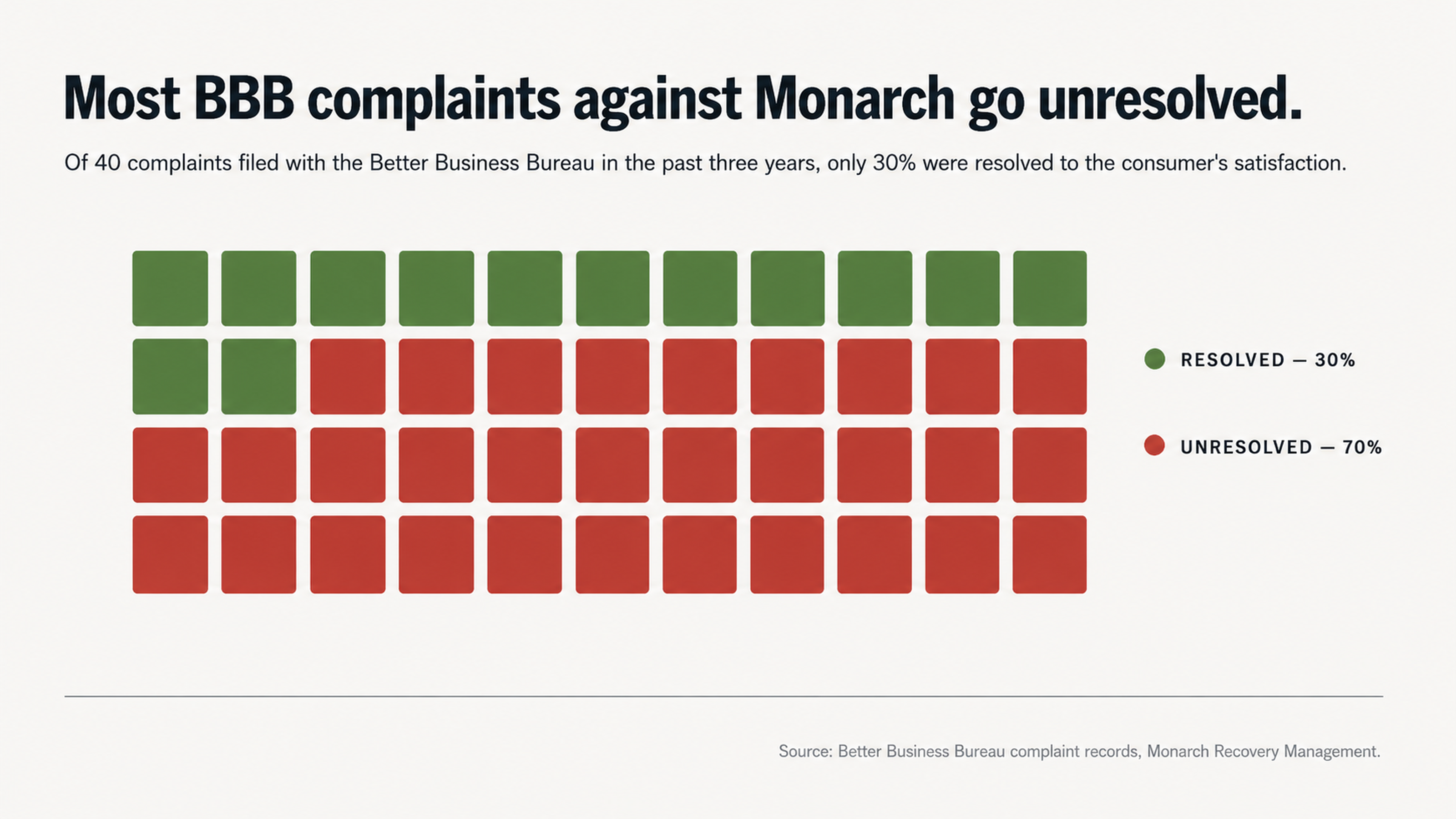
The Better Business Bureau reports 40 complaints against the company in the last three years, of which only 30 percent were resolved to the consumer's satisfaction. The company's average consumer review rating is just 1.3 out of 5 stars on Google Reviews.
Here's what one consumer had to say in a complaint filed with the Better Business Bureau: "These people do not listen. They have called me countless times, despite me telling them they have the wrong number, and I am NOT the person they keep asking for. I have told them I am not the guy they want, and have told them to delete my number, yet they keep calling me trying to get me to pay a debt that quite literally isn't mine."
Why So Many Mistakes Happen
Debt collection agencies like Monarch Recovery Management buy debt portfolios, which contain thousands of individual debts, at a time. Often, these portfolios are nothing more than spreadsheets containing names, phone numbers, and balances due. The original documentation that proves the debt is often missing or incomplete.
Collectors calling on accounts often have minimal training and less time. They are incentivized by the number of phone calls they make and the number of payments they secure, not by how carefully they verify each debt. In this environment, mistakes are inevitable.
When the original creditor sells a debt to a collection agency, they have already written it off as a loss. They have no financial incentive to ensure the collection agency gets the right person. When you feel morally obligated to pay a debt just because a collection agency says you owe it, that obligation is often disconnected from the reality of how that debt ended up in collections.
Autodialer Abuse
One particularly egregious example of the company's practices was exposed in a legal case called Lynn v. Monarch Recovery Management. In this case, the Fourth Circuit Court ruled that Monarch Recovery Management had made 37 autodialed calls to a consumer's residential landline phone in violation of the Telephone Consumer Protection Act.
The case highlights the way collection agencies will blast thousands of calls out using automated systems without carefully verifying whether they have the right phone number, let alone the right person.
Your best response to an autodialed call from a debt collector is not to answer it. Instead, let the call go to voicemail and make a note of the date and time. Then work with a reputable credit repair expert to use that information to your advantage.
When the Collector Can't Verify
What to Do When Monarch Recovery Can't Verify the Debt
The FDCPA says that debt collectors must verify the debts they are collecting when consumers ask them to. To meet their burden of proof, they must be able to show that the amount they are asking for is correct, that you are indeed the person who owes the debt, and that the collector has a right to collect it.
In many cases, debt collectors are unable to verify debts when consumers challenge them. In the case Rocke v. Monarch Recovery Management, the court ruled that a collection letter sent by Monarch Recovery Management contained a false representation because it told consumers they had to dispute a debt "in writing" when the FDCPA does not impose that requirement.
When a collection agency is unable to verify a debt, that debt should be deleted from your credit report. This isn't a technicality or a loophole. It's how the FDCPA is supposed to work. The burden of proof is always on the debt collector, never on you.
Class Actions Highlight Patterns of Abuse
Monarch Recovery Management has been the subject of multiple class action lawsuits over its collection letter practices. In one such case, called Eloisa v. Monarch Recovery Management, a federal court certified a class of about 331 consumers who had all received the same problematic collection letter from Monarch about debts owed to Synchrony Bank.
When the same thing happens to hundreds of different consumers, it isn't a coincidence. It's a pattern of abuse. These class actions demonstrate that the problems we see in individual complaints aren't just isolated incidents. They are symptoms of systemic problems with the way Monarch Recovery Management operates.
These class actions also provide a kind of roadmap for other consumers who want to dispute their debts and repair their credit. They demonstrate that there is established legal precedent for recognizing that Monarch Recovery Management's practices are a problem.
Why You Shouldn't Pay First
Why Paying Monarch Recovery Management May Be a Huge Mistake
Lots of consumers believe that if they pay a collection account, it will somehow help their credit score. In reality, paying a collection account doesn't improve your credit score much because the account will remain on your credit report as a paid collection. The damage is already done. Paying it simply confirms that the account was legitimate.
Debt collectors use the fear of having a negative mark on your credit report to pressure you into making a payment as quickly as possible. They know you want it to go away, and they use that fear to their advantage.
Here's what one consumer said in a complaint to the Better Business Bureau: "I had an option to choose a plan to pay Monarch Recovery $699.74 in two payments; however, when I clicked on the option their online system took $2,798.93." The consumer was unable to get in touch with anyone at the company to correct the overcharge. Rushing to pay can actually create more problems than it solves.
Dispute First
The Smart Way to Handle a Collection Account
Instead of paying a collection account, the smart strategy is almost always to dispute it first. If the account is inaccurate, or it's fraudulent, or the collector simply can't verify it within a reasonable amount of time, you may be able to have it completely removed from your credit report.
As we've established, more than three-quarters of credit reports contain some kind of mistake. So it makes sense to approach every collection account with a healthy dose of skepticism. The debt collector paid pennies on the dollar for your debt and likely doesn't have the documentation to prove it. Why should you just accept their version of events without verifying it?
Credit repair experts understand the dispute process and know what documentation debt collectors are required to provide. They can spot the flaws in a collection account and develop an effective dispute strategy. That puts you in a position of power. Once you pay the account, that power is gone.
Information Asymmetry
What the Debt Collectors Know That You Don't
Professional debt collectors spend all day every day navigating federal and state collection laws and dealing with consumer responses to their collection activities. They know which buzzwords tend to get an emotional response. They know that most consumers will never challenge their right to collect. They rely on information asymmetry to maintain their power.
When a debt collector contacts you, you are not on a level playing field. The debt collector has been doing this for years. You may never have dealt with a collection agency before. That information asymmetry is why so many consumers make decisions they later regret.
Strategic silence can be a powerful tool. You do not have to answer the phone every time a debt collector calls. You do not have to provide any information over the phone. You do not have to respond to every demand the debt collector makes. The less you say, the less opportunity the debt collector has to manipulate you.
Reversing the Asymmetry
Working with a credit repair expert reverses the information asymmetry. Credit repair professionals deal with debt collectors every day. They understand debt collector tactics and know how to make debt collectors play by the rules.
Credit repair is, fundamentally, consumer advocacy. It's someone in your corner who understands the rules and can make the debt collector follow them. Everyone deserves that kind of advocacy when they're facing a billion-dollar debt collection industry.
The debt collection industry likes it when consumers feel isolated and overwhelmed. Professional help changes that dynamic and tilts it back in favor of the consumer.
How to Protect Yourself from Monarch Recovery Management
If Monarch Recovery Management is contacting you about a debt, here are some steps you can take to protect yourself:
Document everything: If a debt collector is calling you, start documenting the calls immediately. Log the date and time of every call, even if you don't answer. Keep voicemails, letters, and emails.
Remember the consumer who complained that Monarch Recovery Management called his workplace "EVERY DAY" and immediately hung up when he answered? If he had kept a log of the dates and times of the calls, he would have a potential TCPA violation on his hands. Keeping good records can help you make your case.
Do not engage over the phone: Never speak to a debt collector over the phone if you can avoid it. Anything you say can become part of their notes on your account and may be used against you later.
Written communication provides you with a paper trail that can help protect you.
Understand your leverage: Debt collectors make money when consumers don't understand their rights. They make money when consumers pay without asking questions.
The 270-plus federal lawsuits filed against Monarch Recovery Management demonstrate that its business practices are vulnerable to legal challenge. The class action settlements the company has entered into demonstrate that the courts recognize there are problems with the way Monarch Recovery Management operates.
You have more leverage in this situation than the debt collector wants you to think you do. The key is to use that leverage effectively and avoid making emotional decisions in response to high-pressure tactics.
Conclusion
Monarch Recovery Management has been around for more than 50 years and has been the subject of more than 270 federal lawsuits. The company's business practices, from poor documentation to autodialer abuse, create plenty of opportunities for consumers who know how to effectively challenge a collection account.
Paying a collection account is almost never the right move. Challenging the debt for inaccuracies, demanding verification, and holding the debt collector to account is a much more effective strategy.
The debt collection industry thrives on consumer confusion and fear. Information and professional help are the antidotes.
Ready to Get Started?
Is Monarch Recovery Management on your credit report? Don't face them alone. At FightCollections.com, our professionals are experts at fighting debt collectors and removing mistaken debts from credit reports.
Contact us today for a free consultation. We'll review your case, identify any potential inaccuracies, and come up with a strategy for challenging this collection account. You deserve an advocate in your corner who understands how to fight back.
It's time to stop letting debt collectors dictate the terms of the conversation. It's time to take the first step toward reclaiming your credit.