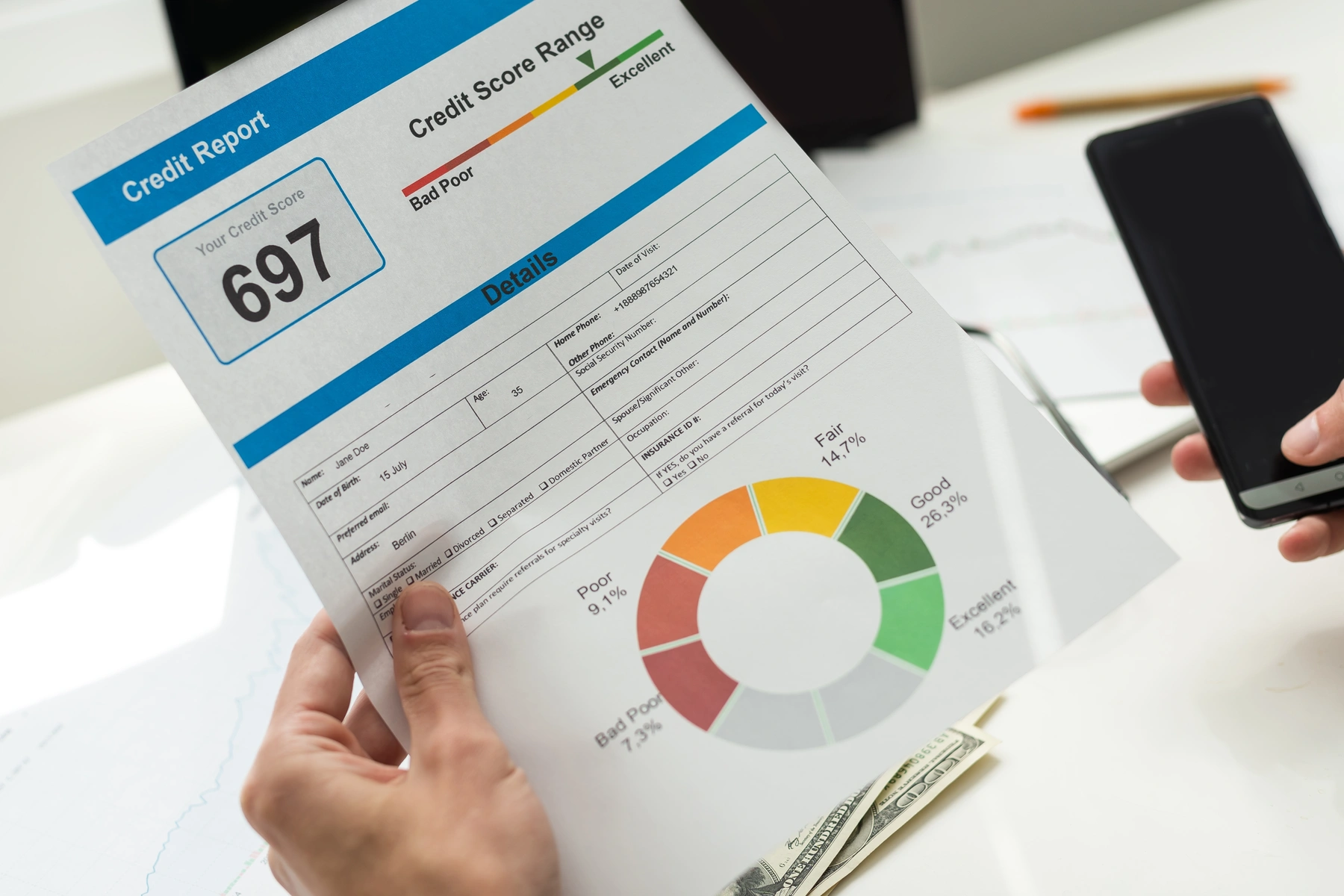

Imagine that you just paid off your car loan. To celebrate, you decide to check your credit score, expecting to see a bump. Instead, you see that your credit score has fallen.
This isn’t a mistake. Paying off a car loan can result in a credit score drop, typically around 15-30 points, but sometimes as much as 50 points or more in some cases. The reason for this has nothing to do with your credit report. Instead, it’s all about how the FICO scoring model works.
Paying off a car loan can cause a temporary drop in credit score, especially if you have a thin credit file.
Why does this matter?
A study by the Federal Reserve Board looked at nearly 200 million car loans and found that 45% were paid off within three years. Since the total outstanding debt on car loans is $1.67 trillion (according to the New York Federal Reserve), that’s millions of people experiencing a drop in credit score each year.
If you’re applying for a mortgage, trying to refinance some debt or attempting to rebuild your credit, a 20-30 point drop can be the difference between approval and denial.
Here’s why this happens and how long it will last. One member of the myFICO forums reported a 27-point drop after BMW Financial Services received the final payment and reported the account as paid and closed on a Friday. By Monday morning, his score had fallen from the 750s to the 720s.
Another consumer lost a perfect 850 FICO credit score across all three bureaus after paying off a car loan early, with a total decline of more than 60 points including other subsequent changes.
Perhaps the most extreme example is that of a TikTok personality, who reported a drop of more than 100 points after paying off a six-year car loan. American Express then cut her credit limit by $2,000 in response, raising her revolving utilization ratio and taking the score down further. It all happened as she was preparing to apply for a mortgage.
Why Some People Lose Far More Than Others
The severity of the drop largely depends on the overall makeup of your credit file. People with multiple open installment accounts, a few active credit cards, and a long history will typically see much smaller declines, often in the 10- to 15-point range. The installment utilization bonus from one loan is partially offset by the remaining active accounts.
Those with thin credit files will suffer the most damage. If your car loan was your only installment account, you lose the entire installment utilization bonus in one event. If the car loan was also one of your oldest accounts, you may also take a hit to the length of your credit history, depending on which scoring model is used.
Ethan Dornhelm, Vice President of Scores and Predictive Analytics at FICO, has publicly pegged the average decline at 10 to 25 points, characterizing credit mix as the smallest of the five FICO factors. But the forum data reveals that when installment utilization and credit mix losses are combined, the decline can top that range.
FICO vs. VantageScore: Why Your Score Drop May Not Be What It Seems
How Each Model Treats Closed Accounts Differently
One of the most underappreciated aspects of this issue is that FICO and VantageScore treat closed accounts in completely different ways. Which model generated your score determines how large the decline appears.
FICO continues to factor closed accounts into its credit age calculation for up to 10 years after the account is closed. A paid-off car loan still counts toward your oldest account age, your average account age and your overall history length. This effectively cushions the blow for most FICO users.
VantageScore only considers open accounts when computing credit age. When a car loan closes, it ceases to contribute to your credit history length. Since Credit Karma shows VantageScore scores, tens of millions of consumers will see a larger decline on their monitoring dashboard than their actual FICO lending score reflects.
What This Means If You Are Applying for a Mortgage
Mortgage lenders are required to use older FICO models known as FICO 2, FICO 4 and FICO 5 when evaluating conventional loans backed by Fannie Mae and Freddie Mac. These legacy models do not weight installment utilization as heavily as the more commonly referenced FICO 8. This means the score your mortgage lender pulls may show little effect, even as your FICO 8 drops by 20 or more points.
Additionally, eliminating a monthly car payment radically improves your debt-to-income ratio, which lenders review separately from credit scores. In many cases, the DTI improvement from paying off a car loan outweighs the modest credit score decline.
What the Regulators and Consumer Advocates Say
Government Criticism of Credit Scoring Model
Government regulators have taken notice of the irony of dinging consumers for paying off debt. The former director of the Consumer Financial Protection Bureau, Rohit Chopra, said that “lenders are telling us at the CFPB that credit scores aren’t predictive anymore,” and called for “reducing the chokepoints from a handful of specific data monopolists in the credit reporting industry.”
A 2012 FTC study on the accuracy of credit reports found that one in five consumers had a credit reporting error corrected after disputing it. Five percent had errors that would lead to less favorable loan terms, such as higher interest rates on an auto loan. Credit reporting issues remain the top complaint category received by the CFPB.
While that wide scale dissatisfaction doesn’t specifically mention the credit scoring paradox of penalizing consumers for paying off an installment loan, it suggests the phenomenon is one of many problems that consumer advocates and regulators believe show the need for reform.
Consumer Advocates Question Fairness of Credit Mix
“Credit scores are a diagnostic that indicate the illness of inequality in society rather than being a cure-all for it,” said Chi Chi Wu, a senior attorney at the National Consumer Law Center. When credit scores are used for decision-making without accounting for inequality, “then they actually perpetuate inequality rather than being a ladder to help people overcome inequality.”
In a 2024 issue brief, the NCLC noted that negative information on credit reports continues to harm consumers long after they’ve recovered from the issue.
“A person who has made all their payments for 5-6 years sees a drop in score at exactly the moment they have demonstrated they are reliable.” Ying Lei Toh, an economist at the Federal Reserve Bank of Kansas City, found that “the traditional credit scoring model… does not provide a level playing field” because people from disadvantaged groups are more likely to have negative information on their credit reports.
The car loan payoff penalty is a smaller-scale version of the same fundamental flaw. So should you still pay off your car loan early?
When Early Car Loan Payoff Still Makes Sense
Despite the short-term dent to credit scores, consumers who can afford to pay off a car loan early almost always should. The average interest rate on a used car loan is now over 11 percent, according to Experian’s State of the Automotive Finance Market report. It doesn’t make sense to pay thousands of dollars in interest in order to protect a 20- or 30-point credit score increase.
For consumers with subprime credit scores, the case is even more clear cut. People with credit scores below 500 face interest rates over 21 percent for used-car loans, according to Experian. Every month those borrowers cut off their car loan saves them money and a 15-point credit score drop that will be erased within a few months is a small price to pay.
In addition, paying off a car loan removes the risk that you could fall behind on payments if you lose your job or face unexpected expenses. If you’ve paid off your car, it can’t be repossessed and the peace of mind that comes with owning your vehicle free and clear has value that may not be measured by your credit score.
Minimizing the Impact of a Car Loan Payoff on Your Credit Scores
Before you make the last payment, check your credit reports and scores to see where you stand before the payoff. If you’re applying for credit or a loan within the next 2-3 months, you may want to delay your final payment for a month or two.
According to Experian, for most people, scores should be back to normal within 1-2 months. In some cases, it may take 3-6 months. Keep your credit card balances as low as possible before and after you pay off your car loan. If you can keep credit card utilization below 10% of your credit limits, that can help counteract the loss of the installment loan credit.
Don’t close old credit accounts, as that will reduce your amount of available credit. Finally, make sure to check your credit reports from each of the three major credit reporting agencies 30-60 days after your final payment to ensure the loan is reported as paid in full and the account is closed with a balance of $0.
Mistakes can happen, and if a paid loan is reported incorrectly, it could hurt your credit score for months or longer.
A Car Loan Payoff Can Temporarily Drop Your Scores
If you pay off a car loan, your credit score could temporarily drop by 15-30 points, possibly more. The main reason for this decrease is the loss of an installment loan credit utilization bonus in the FICO credit scoring model’s amounts owed category.
In some cases, you may also see a slight decrease due to reduced credit mix diversity and average age of accounts. In most cases, the decrease in credit score is minimal and temporary. In no circumstances will the decrease be significant enough to make it a good idea to keep paying interest on the loan instead of paying it off.
The danger here is not the temporary reduction in credit score, but rather the risk that your credit reports contain errors that will lower your credit score more than paying off your car loan. Government studies have shown that credit report errors are extremely common, and millions of consumers are paying higher interest rates than they have to because of errors they didn’t cause and don’t even know about.
If your credit score decreased more than you expected when you paid off your car loan, or if you have collection accounts, charge-offs or other negative information that might be errors, it’s worth investigating.
FightCollections.com Can Help
If you’re facing credit report errors, we can help. At FightCollections.com, we specialize in identifying and disputing unverifiable, inaccurate and misleading information on your credit reports. In many cases, collection agencies will report credit information that is a violation of the FCRA and FDCPA, and you have the right to dispute it.
If you’re experiencing errors related to paid collection accounts, closed loans reported incorrectly or other problems, we can help you navigate your rights. You deserve a credit report that’s accurate, not one that’s marred by data furnisher errors or collection agency shortcuts.
At FightCollections.com, we can help you dispute credit report errors and work towards a cleaner credit report.