

American Coradius International is an ambiguous name, but it may appear on your credit report. And if you have no idea what ACI stands for or why this company is asking for money, you’re not alone.
Before you panic, or worse, pay, you need to understand who ACI is and your rights as a consumer.
American Coradius International (ACI) is a debt collection agency with a long history. The original company was founded in 1989 in Buffalo, New York by Theresa and Bruce Weinstein.
What we know about this collector
ACI has an extensive history documented in federal court records. Over 140 lawsuits have been filed against ACI across the country, with the majority of them alleging violations of the FDCPA. This is a significant number of lawsuits and should be a cause for concern for anyone dealing with this agency.
In 2021 alone, the Consumer Financial Protection Bureau (CFPB) received 145 complaints about ACI, which placed ACI as the 215th most complained about company in the nation.
Within the last three years, the Better Business Bureau (BBB) has received 304 complaints about ACI. In the last year alone, the BBB closed 97 complaints about ACI.
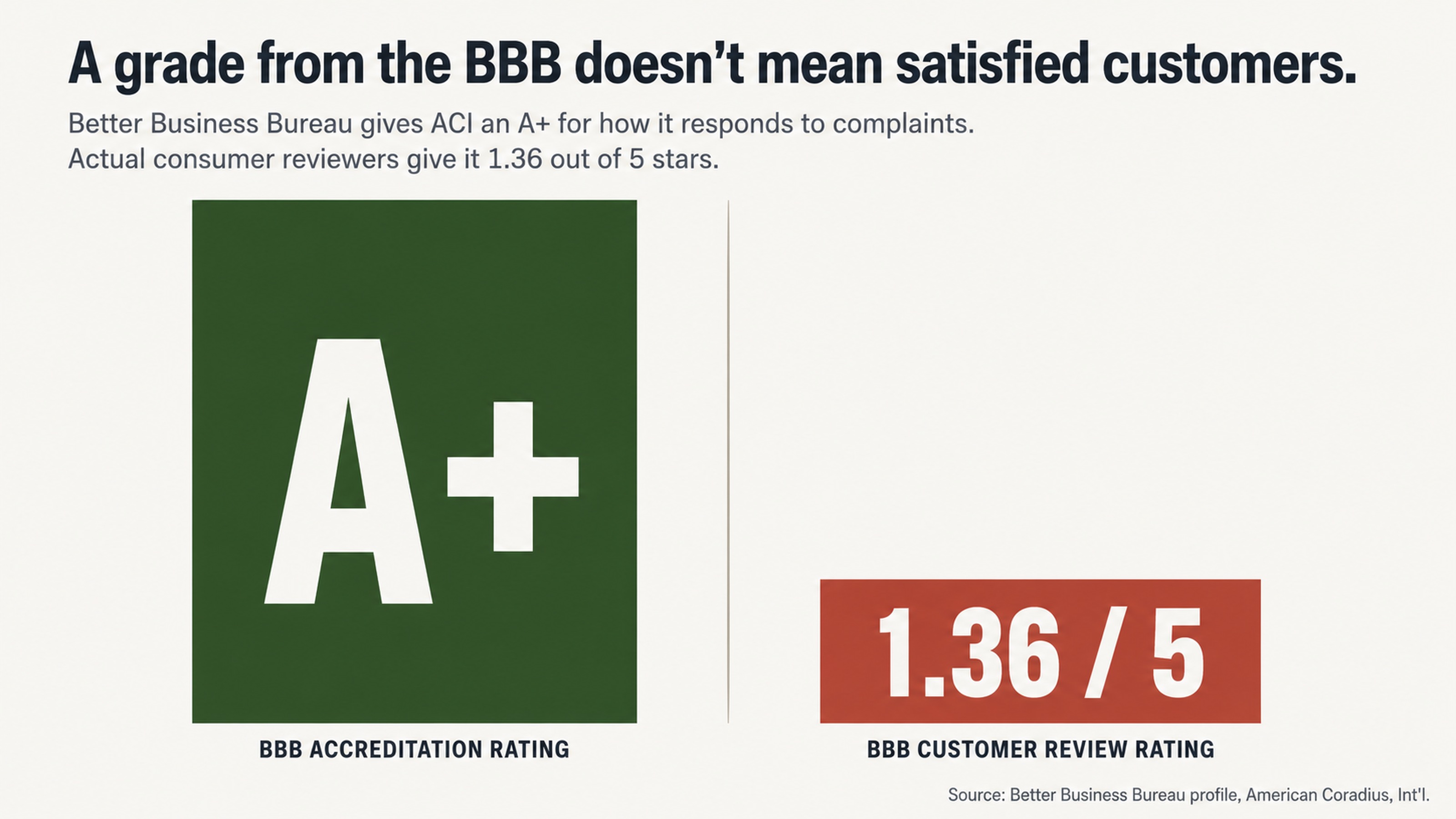
ACI has an A+ rating with the BBB, but the customer review rating is 1.36/5 stars. This is because the BBB states that the customer reviews are not factored into the business rating. The business rating is determined by how the business responds to complaints.
Your rights under the FDCPA
The FDCPA gives you the right to request validation of the debt. You can request validation of any debt that ACI claims you owe. The FDCPA says you have the right to request:
- The amount of the debt.
- The name of the original creditor.
- Proof of ownership of the debt.
- The date of the last payment.
Requesting validation is a powerful tool that you can use in your favor. Not only is it a good defense, but it’s also a good offense. Often, ACI won’t be able to provide the validation you request, which means they have no right to collect the debt.
Within 30 days of initiating a dispute, the burden is on ACI. They have to gather all of the documentation and provide it to you. This process is not only a hassle but also expensive for collection agencies. Many times, it’s cheaper for ACI to simply give up on collecting the debt than it is to continue the process.
What ACI can’t do
The FDCPA outlines what debt collectors can and cannot do. They cannot call you before 8 a.m. or after 9 p.m. your time. They cannot contact you at work if you tell them your employer prohibits it. They cannot use abusive language or threaten you. They cannot misrepresent the amount you owe.
One customer reviewed ACI on the BBB website and said, “This company has their staff lie and manipulate to make you pay. After receiving notice from this company, I called and advised that this was my ex-husband’s debt, and Dominic advised that I still had to pay it. She advised that it would not go to my credit as long as I made monthly payments. I made the first payment and then two weeks later, it was reported on my credit.”
If ACI violates any of these rules, they may owe you statutory damages, actual damages and attorney fees. The FDCPA exists because debt collectors have historically preyed on consumers’ lack of knowledge to get them to pay debts they may or may not owe.
Why you shouldn’t pay
There are several reasons you might want to pay a debt that’s in collections. However, there are also several reasons why you shouldn’t pay.
Paying the debt doesn’t mean it will be removed from your credit report. When you pay a debt in collections, it will show as a paid collection account on your report. Unfortunately, it will remain on your report for seven years from the original delinquency date.
You could inadvertently renew the statute of limitations. Depending on your state, if you make a payment on an old debt, you could renew the statute of limitations. This means a debt that previously couldn’t be collected because it was too old may now be collectable again.
Instead of paying, gather all the information you need and understand your rights before you make a decision. Debt collectors want you to feel like you need to respond right now. They use high-pressure tactics to get you to pay without taking the time to consider whether this is a debt you owe or whether ACI has the legal right to collect it. The best thing you can do is slow down and ask for documentation.
Inaccurate credit reports
This might sound unbelievable, but credit reports are rarely accurate. In fact, a study done by U.S. PIRG found that 79% of credit reports contain errors or serious errors. Credit bureaus process millions of pieces of data every day, and they prioritize speed over accuracy. They add information to your report without verifying its accuracy, and errors can remain on your report for years if you don’t dispute them.
We’ve already talked about how ACI has over 140 lawsuits filed against it and hundreds of complaints with the CFPB and BBB. Many of those complaints are about inaccurate information. Several customers have said ACI is trying to collect a debt from PayPal that doesn’t exist.
One customer left a review on Google and said, “This is a total scam. Call PayPal directly. We have been getting calls from this company stating we owe PayPal $2000+ and we do not even have a PayPal account. I called PayPal directly and they do not have an account for me or my husband, a collection for me or my husband, nor does PayPal have any record of us ever owing them any money.”
If ACI is claiming you owe a debt that doesn’t exist or the information on your report is not accurate, you have every right to dispute it.
How to protect yourself from ACI
ACI only needs one thing from you: Information. ACI uses the information you provide against you. They want to know your social security number, your bank account information, where you’re employed and any other information about your finances they can get. The best way to protect yourself is to ensure the only information you’re sharing is the information ACI is giving you.
When ACI calls you, they’re trying to get as much information from you as possible. They may ask you seemingly innocent questions, but their goal is to find a way to collect the debt. You don’t have to answer their questions. Under the FDCPA, you have the right to written validation of the debt. Instead of answering questions over the phone, initiate the validation process.
You can also request all future communication come in writing. This is a good idea for several reasons.
First, it creates a paper trail so you have a record of everything ACI sends you. Second, it prevents any miscommunication. If it’s in writing, there’s no way ACI can claim you said something you didn’t. Finally, it forces ACI to put its claims in writing.
If ACI is accusing you of owing a debt you don’t owe or the information on your report is inaccurate, making them put it in writing will help you in your dispute.
Exemptions from garnishment
One of the biggest threats ACI can make is to garnish your wages or take your assets. However, there are federal and state exemptions that protect some of your property. Federally, the following funds are exempt from garnishment:
- Social Security benefits
- Veterans benefits
- Certain retirement accounts
Most states offer additional exemptions. In many states, ACI can only take a portion of your wages and certain assets. ACI may not tell you about these exemptions because it doesn’t want you to know you’re protected. But the truth is, even if ACI takes you to court and gets a judgment against you, there are exemptions in place to protect your ability to meet your basic needs.
Fair Credit Reporting Act
The FCRA gives you additional rights when you’re dealing with ACI. Under the FCRA, credit reporting agencies have to investigate disputes within 30 days. If ACI can’t provide documentation to support its claims, the credit reporting agency has to remove the information from your report.
Why you need a professional to help
There are several reasons you should consider hiring a professional to help you with your dispute.
Knowledge of the law
Debt collection agencies know the law and how to use it to their advantage. Many consumers do not know the law as well as debt collection agencies do, which puts them at a disadvantage. If you try to navigate the system on your own, you may inadvertently do something that hurts your case.
Experience
Consumer law firms have experience with debt collection agencies. Not only do they understand the law, but they also have dealt with collection agencies before. They know all the tactics and tricks that ACI will use to try to collect the debt. Let them put their experience to work for you.
Knowledge of what ACI has done in the past
There have been several class-action lawsuits against ACI. In many of the lawsuits, it’s alleged that ACI violated the law.
For example, in July 2018, a class-action lawsuit was filed against ACI. The plaintiff claimed that ACI was not clear in its collection letters about how much money it would accept as payment in full and it did not disclose if it was going to continue to charge interest on the debt. The plaintiff also claimed ACI told consumers they had to put their disputes in writing even though the law does not require that.
Professional credit repair
If you’re not sure where to start or how to dispute ACI’s claims, you should consider working with a professional credit repair company. It has the knowledge and experience you need to navigate the system successfully. Not only can it help you with this dispute, but it can also help you repair your credit.
There’s nothing ACI can do to stop you from disputing the debt. In fact, there’s nothing ACI can do to stop you from working with a professional. You have the right to hire anyone you want to help you with your dispute.
Conclusion
There’s nothing ACI can do to you or your credit report that you can’t fight. ACI may have placed a collection account on your report, but that doesn’t mean you owe it. ACI may be accusing you of owing a debt you don’t owe or it may not have the legal right to collect it.
The most important thing you can do is understand your rights. If you do owe ACI money, you have the right to make payments or settle the debt. However, if you don’t owe ACI money or if ACI doesn’t have the right to collect it, you have the right to dispute it and have it removed from your report.
Don’t give up!
Do you need help with American Coradius International? We can assist you! Call us today for a free consultation.