

Receiving a notice from Bonneville Collections can feel like a gut punch.
First, you feel embarrassed. Then you feel concerned about the impact on your credit and the future. In many cases, the response is to ignore the issue and hope that it goes away. It’s easy to ignore the problem, but that’s a strategy that keeps you from taking action.
The truth is, you have more control over this issue than Bonneville Collections wants you to know. With the right information and tools, you can take control of your credit and your financial future.
Who is Bonneville Collections?
Bonneville Billing and Collections, Inc. is a third-party debt collection agency based in Utah. Bonneville Collections was founded on May 19, 1980.
Bonneville Collections has other locations in Boise, ID; Idaho Falls, ID; and Vancouver, WA. They collect primarily for medical, utilities, government, and retail accounts.
What the Record Shows about This Debt Collector
Information about Bonneville Collections, its business practices, and the way it treats its customers is publicly available.
In June 2000, the U.S. Court of Appeals for the 10th Circuit ruled that Bonneville violated the Fair Debt Collection Practices Act in Heard v. Bonneville Billing and Collections. The court ruled that Bonneville attempted to collect a debt from the consumer that she did not owe and that Bonneville had a “routine practice” of attempting to collect from joint account holders who may not have actually been liable for the debt.
As a result of the federal court judgment, Bonneville was ordered to pay Heard $42,416.82 in damages.
Perhaps more importantly for consumers who are wondering whether they actually owe the debt that Bonneville is trying to collect from them, the case established that Bonneville has a history of attempting to collect debts from consumers without verifying whether the consumer actually owes the debt.
The Consumer Financial Protection Bureau (CFPB) received 193 complaints about Bonneville Collections in 2013. As of March 2024, the Better Business Bureau (BBB) has received 81 complaints about Bonneville in the past 3 years. That makes a total of at least 274 complaints that have been filed against Bonneville with these two agencies alone.
Nearly half of the complaints filed with the CFPB (46 percent) related to problems with billing and collections, while another 16 percent of the complaints related to documentation and verification of debts. Similarly, the most common complaints filed with the BBB (49 percent) related to billing and collections issues. Another 14 percent of the complaints filed with the BBB related to customer service issues.
The Psychology that Debt Collectors Use Against Consumers
Fear and Urgency
Debt collectors use urgency and fear as a tactic to get consumers to pay as quickly as possible. The debt collector wants the consumer to believe that he or she must act now or face severe consequences. Urgency is a tool that debt collectors use to prevent consumers from doing their research and taking the time to understand their rights and options.
Consumers who have dealt with Bonneville Collections describe this sense of urgency and fear in reviews they have written about the company. In 2019, one consumer wrote on the BBB website: “[Bonneville Collections] threatened me with garnishment and lawsuit. I was harassed, belittled and threatened to the point that it affected my health.”
This consumer was not describing a situation in which Bonneville was helping her resolve a legitimate debt. Instead, she was describing a situation in which Bonneville was threatening and intimidating her in an attempt to force her to pay a debt without taking the time to verify whether she actually owed the debt.
The reality is that very few situations involving debt collection require immediate action. In most cases, consumers have time to verify the debt, research their options, and come up with a plan before taking action.
Shame
Debt collectors prey on consumers’ sense of shame. Many consumers feel embarrassed that a debt has gone to collections and that a debt collector is calling them. Debt collectors use this sense of shame to their advantage. Debt collectors know that consumers who feel guilty and embarrassed are more likely to pay a debt without asking questions or verifying whether they owe the debt.
As noted above, research suggests that as many as 79 percent of credit reports contain errors or inaccuracies, according to U.S. Public Interest Research Groups. This means that many consumers who are contacted by debt collectors may not actually owe the debt that the debt collector is attempting to collect.
When consumers feel shame about a debt, they are less likely to take the steps necessary to verify whether they owe the debt and more likely to simply pay the debt to make the situation go away.
Why You Should Not Pay a Debt Before Disputing It
Payment Will Not Get a Collection Removed from Your Credit Report
Many consumers believe that if they pay a collection, the collection will be removed from their credit report. Unfortunately, that is not accurate. If you pay a collection, the status of the collection account on your credit report will change from “unpaid collection” to “paid collection,” but the collection will still remain on your credit report for up to 7 years.
Paying a collection does not mean that the negative information will be removed from your credit report. That is why it is so important to dispute any information on your credit report that you believe is inaccurate or incorrect before paying a collection. If you are able to successfully dispute the information and get it removed from your credit report, you will not have to pay the collection at all.
You May Not Actually Owe the Debt
Collectors can make mistakes when listing a debt. In some cases, the creditor may have made a mistake when reporting the debt to the credit reporting agencies. The debt collector may have incorrect information about how much you owe on the debt. You may not actually owe the debt at all. For example, the debt may not belong to you or the debt may be too old to be reported on your credit report. Regardless of the reason, you should not pay a debt until you have verified that it is accurate and valid.
Bonneville Collections has a history of attempting to collect debts from consumers that the consumers do not owe, according to a ruling by the U.S. Court of Appeals for the 10th Circuit in Heard v. Bonneville Billing and Collections. Before providing a debt collector with any information about your debts or making a payment on a debt, you should verify that the debt is accurate and valid. Information that you provide to a debt collector about your debts could potentially be used against you, so it is generally best to insist that all information flow from the debt collector to you.
Your Rights Under the Law
You Have the Right to Tell a Debt Collector to Stop Contacting You
Under federal law, you have the right to tell a debt collector to stop contacting you. You do not have to talk to a debt collector on the phone or respond to letters or emails from a debt collector.
In fact, telling a debt collector to stop contacting you may be the best option for dealing with a debt collector that is engaging in harassment or abusive behavior. You have the right to stop a debt collector from contacting you at any time, and exercising that right is not rude or an attempt to avoid your debts. Instead, it is your right under federal law.
To stop a debt collector from contacting you, you will need to provide a written request to the debt collector. You can send a letter or email to the debt collector telling the debt collector that you do not want to be contacted again. Once the debt collector receives your request, the debt collector must stop contacting you, except in very limited circumstances.
For example, a debt collector may contact you again to tell you that collection activities have ended or to notify you that the debt collector or creditor intends to take a specific action, such as filing a lawsuit.
In some cases, debt collectors attempt to collect debts from consumers in ways that violate their rights under federal law. For example, debt collectors may attempt to collect debts from consumers at their workplace or during odd hours, such as early in the morning or late at night. Debt collectors may threaten or harass consumers or use deceptive practices to attempt to collect debts.
Consumers who have dealt with Bonneville Collections describe situations in which the debt collector violated their rights in this way. In March 2024, one consumer wrote on the BBB website: “[Bonneville Collections] called my family member asking for my phone number… while admitting they had my phone number. How is this legal when they never tried to contact me direct first in any form?”
You do not have to tolerate this kind of abusive behavior from a debt collector. You have the right to tell a debt collector to stop contacting you, and you should exercise that right if a debt collector is engaging in this type of behavior.
Debt Validation is Your Right
When a debt collector first contacts you about a debt, the debt collector is required to provide you with certain information about the debt, including the amount of the debt, the name of the creditor, and a statement of your rights under the Fair Debt Collection Practices Act. You also have the right to request “debt validation” or verification of the debt.
When you request debt validation, you are asking the debt collector for proof that you owe the debt. The debt collector must provide you with verification of the debt before continuing collection activities.
In some cases, a debt collector may not have the documentation necessary to verify a debt. This may occur when the original creditor has sold the debt to a debt collector, and the debt collector does not have access to all of the information about the debt. For example, the original creditor may have information about the debt, such as the original contract or payment records, that the debt collector does not have access to.
In other cases, a debt collector may simply refuse to provide verification of a debt to a consumer. This may occur when the debt collector is attempting to collect a debt that the consumer does not owe or when the debt collector is engaging in other abusive or deceptive behavior.
Consumers who have dealt with Bonneville Collections describe situations in which the debt collector refused to provide verification of a debt.
For example, one consumer wrote on the BBB website: “Agent told me they do not provide written contracts as ‘a verbal agreement is good enough.’” The same consumer indicated that Bonneville engaged in “failure to provide written proof of debt” and “failure to provide written agreement of payment arrangement.”
If a debt collector is unable to verify a debt, you may be able to get the information removed from your credit report. That is why it is so important to dispute information on your credit report before paying a debt.
The BBB Rating of Bonneville Collections
Why Letter Grades Do Not Mean Everything
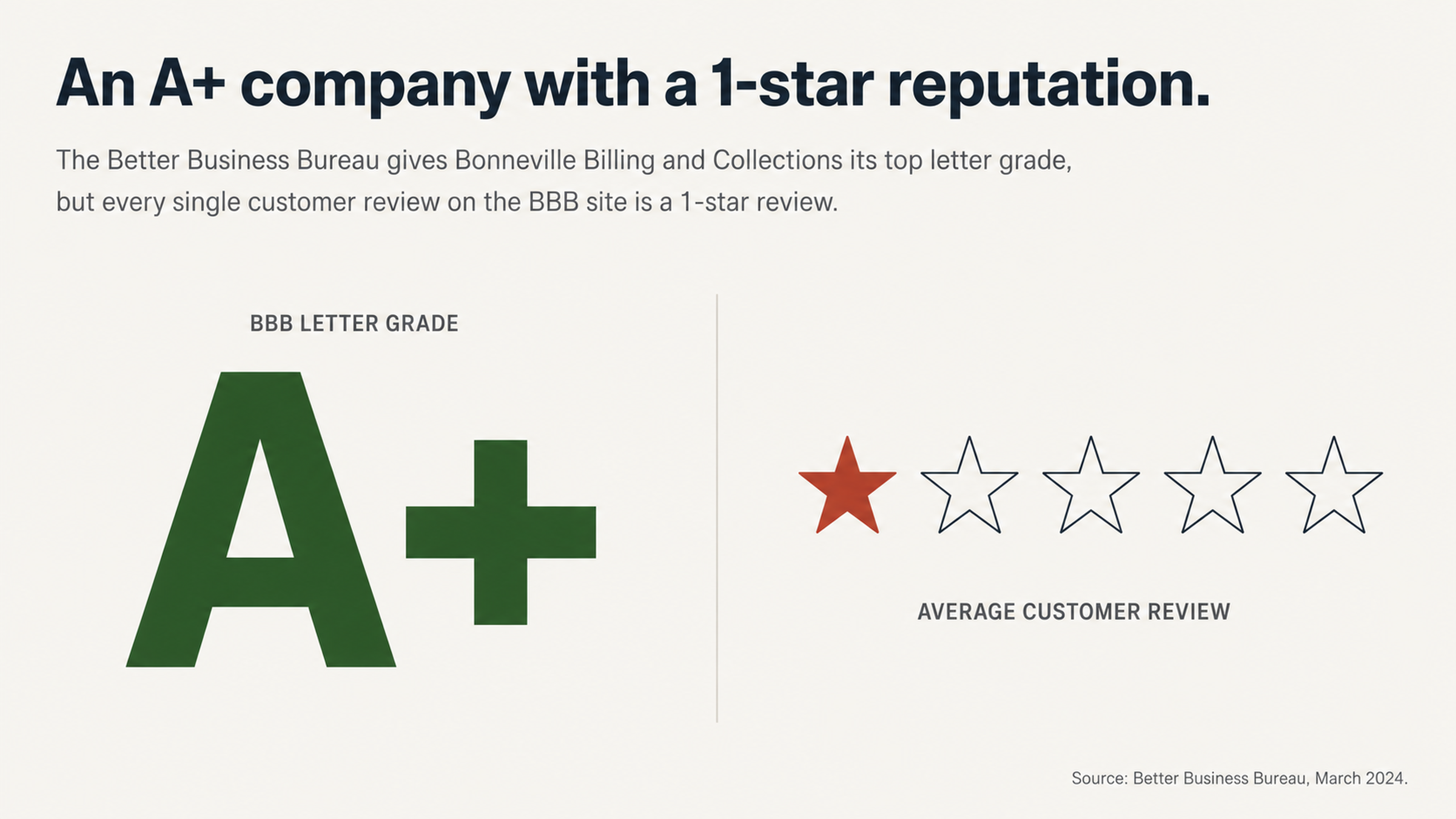
Bonneville Collections has an A+ rating from the Better Business Bureau (BBB), as of March 2024. At first blush, this may seem like a positive sign for a debt collection agency. However, it is essential to look at all of the information available about a company on the BBB website, rather than relying solely on the company’s letter grade.
On the BBB website, Bonneville Collections has an A+ rating, but the company has an average customer review rating of 1 out of 5 stars. Every customer review of Bonneville Collections on the BBB website is a 1-star review.
So why the discrepancy between Bonneville Collections’ A+ rating and its average customer review rating?
The reason is that the BBB calculates letter grades based on different criteria than average customer review ratings.
To calculate a company’s letter grade, the BBB considers a range of factors, including: The company’s complaint history with the BBB. The type of business and industry. The length of time the company has been operating. The transparency of the company’s business practices. Whether the company has appropriately responded to and resolved complaints filed with the BBB. The company’s advertising practices.
On the other hand, average customer review ratings are calculated based solely on reviews from customers. Generally, this means that a company can maintain a high letter grade from the BBB even if customers are not happy with the service they receive from the company, as long as the company is responding to and resolving complaints filed with the BBB and engaging in other good business practices.
In the case of Bonneville Collections, the company has a high letter grade from the BBB because it has responded to the complaints that have been filed against it with the BBB. However, customers who have dealt with Bonneville Collections are not happy with the service they received from the company. In fact, every review of the company is a 1-star review, the lowest rating available.
Systemic Problems with a Debt Collection Agency
Complaints filed against a debt collector are essential because they document a pattern of abuse or problems with a debt collector’s business practices. If many consumers are filing complaints against a debt collector raising the same issues, the problem is likely systemic.
The pattern of complaints filed against Bonneville Collections on the BBB website suggests systemic problems with the debt collector’s business practices. Of the complaints filed against Bonneville Collections, 49 percent relate to problems with billing and collections, while another 14 percent relate to customer service issues.
Similarly, 68 percent of reviews of Bonneville Collections on WalletHub are 1-star reviews. This pattern of complaints across different review platforms suggests a systemic problem with Bonneville Collections’ business practices.
How a Professional Credit Repair Service Can Help
Knowledge is power for consumers who are dealing with debt collectors. Unfortunately, debt collection agencies have a significant knowledge advantage over consumers. Debt collectors are professionals who do this work every day. They understand the federal laws that apply to debt collection and the strategies for collecting debts from consumers.
Many consumers only deal with debt collectors once or twice in their lifetime, and as a result, they do not have the same level of knowledge or understanding about their rights or how to effectively deal with a debt collector. In some cases, consumers may not even understand the situation or options available to them.
One consumer who dealt with Bonneville Collections described this lack of understanding in a review on the BBB website. The consumer indicated that she had attempted to make a payment to Bonneville Collections but was treated so poorly by the representative with whom she spoke that she refused to work with that representative. The consumer asked Bonneville Collections to have another representative contact her, but she did not hear from anyone for a month.
At that point, she received a court summons indicating that Bonneville Collections was suing her. “[I] have never been sued!!” she wrote. “Why? Because I pay my debt!”
This consumer’s situation is not uncommon. Many consumers do not understand their rights or options when dealing with a debt collector, and as a result, the process can be overwhelming.
A professional credit repair service can help consumers understand their situation and options and develop an effective strategy for dealing with a debt collector. Credit repair specialists understand how to effectively dispute information on credit reports and how to document and file complaints against debt collectors.
In addition, credit repair specialists understand how to communicate effectively with debt collectors and negotiate on behalf of their clients.
The Dispute Timeline is on Your Side
When you dispute information on your credit report, the credit reporting agency must investigate and verify the information within a specific period of time (typically 30 days). If the creditor is unable to verify the information within that time period, the information may be removed from your credit report.
This process works to your advantage if you understand how to use it effectively. If you miss the deadline or fail to follow the right procedures, you are giving up some of the leverage you have in this situation.
Conclusion
If you see Bonneville Collections on your credit report, you may feel anxious about the situation. But you are not powerless. Bonneville Collections is a debt collection agency with a history of violating consumers’ rights under federal law and engaging in abusive practices. The company has lost a federal lawsuit and faces hundreds of complaints from consumers about its practices.
You do not have to live with the anxiety and stress of a debt collection situation. Disputing inaccurate or unverifiable information on your credit report is not a loophole or technicality. It is your right under federal law. You should never assume that you owe a debt simply because a debt collector says you do. Instead, verify that any debt is valid and that you owe it before making a payment or providing financial information to a debt collector.
What’s Next?
You do not have to navigate a debt collection situation on your own. At FightCollections.com, we help consumers challenge collection accounts through the proper dispute procedures. We understand the documentation and timelines involved and the strategies that work when dealing with debt collectors like Bonneville Collections.
If you see Bonneville Collections on your credit report, contact us for a free consultation. We can review your situation and help you understand your options for moving forward.